Public lecture by Professor Larry Hurtado
Professor of New Testament Language, Literature & Theology and Director
of the Centre for the Study of Christian Origins at the University of Edinburgh.
Date: Friday, 3 August, 2.00 - 3.30pm
Venue: TTC's Multi-Purpose Hall
Topic: "Jesus - Devotion in Recent Scholarship"
Professor Hurtado has this to say about his work: my own research has always been driven by questions: how the New Testament came to us, how the Gospels were transmitted in the early centuries, what this or that passage means, how the early Christians adapted traditions from their religious background and how they innovated, how their worship began and how it was shaped, how they accommodated Christ along with God in their devotional life, how Christian belief and practice was shaped by opposition and historical developments of the first two centuries . . .
Ichthus Seminar Series
"Binitarian Monotheism: God and Jesus in the NT"
By Prof Larry W. Hurtado
Date & Time: 3 August 2007 7.30 pm
Singapore Bible College
9-15 Adam Road Singapore 289886
Abstract
"In a number of publications over the last 20 years, I have sought to analyze in historical terms the emergence and earliest manifestations of devotion to Jesus, particularly devotion to him as in some way sharing divine status, significance, and attributes. In this presentation, I draw upon this body of work. The major emphases will be on the historical significance of this devotion to Jesus, a phenomenon without true precedent or analogy at the time of its origin, and on the resulting impact upon the early Christian understanding of God. I contend that the earliest Jesus-devotion directly demanded and shaped the development of Christian thinking and practice that led later to the doctrine of the Trinity."
About the Speaker
Larry Hurtado is Professor of New Testament Language, Literature and Theology in the University of Edinburgh (since August 1996), and Director of the Centre for the Study of Christian Origins.
His publications include an influential study of the early textual history of the Gospel of Mark (Text-Critical Methodology and the Pre- Caesarean Text: Codex W in the Gospel of Mark [Eerdmans, 1981), a popular-level commentary on the Gospel of Mark (Mark: New International Bible Commentary [Hendrickson, 1989]), a frequently- cited study on the origins of the worship of Christ (One Lord, One God: Early Christian Devotion and Ancient Jewish Monotheism [Fortress Press, 1988; 2nd edition 1998, repinted 2003, T. & T. Clark]), a small volume on earliest Christian worship (At the Origins of Christian Worship: The Context and Character of Earliest Christian Devotion [Paternoster Press, 1999; Eerdmans, 2000]), a major study focused on the first two centuries of Christianity, Lord Jesus Christ: Devotion to Jesus in Earliest Christianity (Eerdmans, 2003), and How on Earth did Jesus Become a God? Historical Questions about Erliest Devotion to Jesus (Eerdmans, 2005). His most recent book, The Earliest Christian Artifacts: Manuscripts and Christian Origins (Eerdmans, 2006), demonstrates how Christian manuscripts of the second and third centuries CE throw important light on a number of wider historical questions about early Christianity.
In addition, he has published over 60 articles in scholarly journals, books and reference works on the New Testament and origins of Christianity. He has done editorial work on several publications, including the Dictionary of Biblical Tradition in English Literature (Gen. Editor D. L. Jeffrey, Eerdmans, 1992), for which he was the Associate Editor.
Starting in 2001, he convened an international team of scholars under the auspices of the Society of Biblical Literature to undertake fresh studies of the Freer biblical manuscripts, their work published by the SBL in 2006 (in observance of the centenary of the acquisition of these manuscripts by Charles Freer): The Freer Biblical Manuscripts: Fresh Studies of an American Treasure Trove, ed. L. W. Hurtado (Society of Biblical Literature, 2006).
He also served on the editorial board of Studies in Religion/Sciences religieuses, and as an Associate Editor of Critical Review of Books in Religion, and is currently also a member of the editorial board of the Journal for the Study of the Historical Jesus, TC: A Journal of Biblical Textual Criticism, and Expository Times.
He has given invited lectures in a number of colleges and universities in the U.S., Canada, Britain, Israel, Australia, New Zealand, Singapore, and Germany.
Prior to his current appointment, he was Professor of Religion in the University of Manitoba (1978-96), where he was also founding Director of the Institute for the Humanities (1990-92), and Assistant Professor of New Testament in Regent College (Vancouver, BC, 1975-78). He was born in Kansas City, Missouri, in 1943.
Audience
Pastors, theological students, scholars.
Fee
$10 ($5 for SBC students. Free admission for IRC members with their membership card). Fee includes light refreshment to be served 30 minutes before seminar starts.
Registration
Interested parties, please email your name, contact and the event interested in to icht...@sbc.edu.sg, or call +65 6559 1555x7302 for registration and enquiries. Prior registration is preferred due to limited seats. Participants can pay on the day of the seminar.
Saturday, July 21, 2007

Monday, April 02, 2007
Aldersgate 2007
The Rev Dr. David Wilkinson will be speaking at this year's Aldersgate Convention 2007. Dr. David Wilkinson (Principal, St John's College, University of Durham) is a astrophysicist and theologian. He is the keynote speaker for the six-day Aldersgate Convention 2007, addressing the theme “The Heavens Declare His Glory: Science and Christian Faith”.
He received his Ph.D in Theoretical Astrophysics in 1987 at Durham. He went on to do his ministerial training at Wesley House, Cambridge and ministered at three Methodist churches. In 2004 he received his second Ph.D, this time in Systematic Theology, also from Durham. He is active in the World Methodist Council.
While capable of speaking and writing authoritatively in such diverse fields as theology and astrophysics, he has always enjoyed meeting up with youth.
The convention begins with the Adult and Youth Seminars on May 19 and concludes with the Aldersgate Service on May 24.
The Aldersgate Convention is an annual opportunity for Methodists in Singapore to affirm their unity in Christ as they gather together to explore their Wesleyan heritage. In the past, topics have focused on Methodist understandings of the Bible, Tradition, Reason and Experience. During the 2006 Aldersgate Convention, Rev Dr M. Robert Mulholland discusses the topic, “Shaped by the Word”. Other past speakers include Dr Thomas Oden, William Abraham,
and Dr Ajith Fernando.
On Sunday night, May 20, the Methodist School of Music will take the lead in the Aldersgate Hymn Festival at Victoria Concert Hall. Celebrating the Tercentenniel of Charles Wesley, the Hymn Festival will feature several new Asian musical settings for his hymns.
The convention continues with three talks the following three evenings on May 21, 22 and 23, with the themes: “God, the Big Bang and Stephen Hawking”, “Are we alone in the universe? SETI (Search for Extra-terrestrial Intelligence) and God”, and “Left behind, Frozen or Fried?” Beginning at 7.45 pm, the talks will be held at the new Centre for Performing Arts at ACS (Independent) at Dover Road. Church members are encouraged to invite their friends and family members. At the Aldersgate Service on Thursday evening, May 24, the Rev Dr Wilkinson will preach on the topic “The Supremacy of Jesus”. The service, to begin at 7.45 pm, will also be held at the Centre for Performing Arts at ACS (Independent).
--The Methodist Message
Aldersgate Overview
Aldersgate Adult Seminar
Registration required
"Explaining Jesus in a Hi-Tech World"
Saturday, May 19
9 am to 12 noon
Venue: Faith Methodist Church
Aldersgate Hymn Festival
Tickets required
Sunday, May 20, 2007
Please note time change: 7:30 pm
Venue: Victoria Concert Hall
Call Methodist School of Music, 6767-5258
Details
Aldersgate Evening Talks
No registration or tickets required
Monday - Wednesday, May 21-23, 2007
7:45 to 9:30 pm each night
Venue: ACS (Independent)
Aldersgate Service
No registration or tickets neededThursday, May 24, 2007
7:45 to 9:45 pm
Venue: ACS (Independent)
He received his Ph.D in Theoretical Astrophysics in 1987 at Durham. He went on to do his ministerial training at Wesley House, Cambridge and ministered at three Methodist churches. In 2004 he received his second Ph.D, this time in Systematic Theology, also from Durham. He is active in the World Methodist Council.
While capable of speaking and writing authoritatively in such diverse fields as theology and astrophysics, he has always enjoyed meeting up with youth.
The convention begins with the Adult and Youth Seminars on May 19 and concludes with the Aldersgate Service on May 24.
The Aldersgate Convention is an annual opportunity for Methodists in Singapore to affirm their unity in Christ as they gather together to explore their Wesleyan heritage. In the past, topics have focused on Methodist understandings of the Bible, Tradition, Reason and Experience. During the 2006 Aldersgate Convention, Rev Dr M. Robert Mulholland discusses the topic, “Shaped by the Word”. Other past speakers include Dr Thomas Oden, William Abraham,
and Dr Ajith Fernando.
On Sunday night, May 20, the Methodist School of Music will take the lead in the Aldersgate Hymn Festival at Victoria Concert Hall. Celebrating the Tercentenniel of Charles Wesley, the Hymn Festival will feature several new Asian musical settings for his hymns.
The convention continues with three talks the following three evenings on May 21, 22 and 23, with the themes: “God, the Big Bang and Stephen Hawking”, “Are we alone in the universe? SETI (Search for Extra-terrestrial Intelligence) and God”, and “Left behind, Frozen or Fried?” Beginning at 7.45 pm, the talks will be held at the new Centre for Performing Arts at ACS (Independent) at Dover Road. Church members are encouraged to invite their friends and family members. At the Aldersgate Service on Thursday evening, May 24, the Rev Dr Wilkinson will preach on the topic “The Supremacy of Jesus”. The service, to begin at 7.45 pm, will also be held at the Centre for Performing Arts at ACS (Independent).
--The Methodist Message
Aldersgate Overview
Aldersgate Adult Seminar
Registration required
"Explaining Jesus in a Hi-Tech World"
Saturday, May 19
9 am to 12 noon
Venue: Faith Methodist Church
Aldersgate Hymn Festival
Tickets required
Sunday, May 20, 2007
Please note time change: 7:30 pm
Venue: Victoria Concert Hall
Call Methodist School of Music, 6767-5258
Details
Aldersgate Evening Talks
No registration or tickets required
Monday - Wednesday, May 21-23, 2007
7:45 to 9:30 pm each night
Venue: ACS (Independent)
Aldersgate Service
No registration or tickets neededThursday, May 24, 2007
7:45 to 9:45 pm
Venue: ACS (Independent)
Friday, January 05, 2007
Forgiveness (1)
Forgiveness
“Forgiveness can refer to three different kinds of relationships: the interpersonal or social forgiveness between two parties, a person’s forgiveness of him or herself, and God’s forgiveness.” (Aaron Lazare, On Apology, p. 230) I think any discussions on the topic of forgiveness have to start with God’s forgiveness. Thus, a pre-understanding of man’ fallen state is needed.
God’s forgiveness of Man In a Fallen State
In the creation account of Genesis, we are introduced to God the Creator who made the heavens, the earth, and all that dwell on earth, including human beings. However, sin entered the human race when Adam and Eve sinned (Genesis 3). But how do we know original sin is true/ real? Isn’t it outdated? As G K Chesterton once said, original sin is the only doctrine one can confirm by reading the front page of the daily newspaper. After Adam, with the influence of original sin, “holding grudges and seeking revenge” seems to come to us naturally. The fall of mankind results in the need for forgiveness, both from God and between individuals (though both are also inextricably linked). As Susan L. Nelson puts it, the doctrine of original sin has meant that it is impossible for human beings not to be involved in sin in some way:
Forgiveness means giving up our illusions of innocence. The Presbyterian insistence on the doctrine of original sin has meant that we realize it is impossible for human beings not to be involved in sin in some way. To live in the First World, with all our advantages, is by definition to reap from others' hard work. We [Americans] live off of others' suffering, and thus we are complicit in that suffering. Forgiveness means giving up postures of innocence--and all the tactics of cover-up and denial that take so much energy and only make matters worse. In the context of God's grace, we do not need to proclaim our innocence, but to seek ways to rectify the injustice in which we participate. [What Presbyterians Believe, Forgiveness [March 1998]; emphasis in bold is mine]
Sunday, December 31, 2006
Why should I believe the bible?
Before the start of another year, it is important that we affirm what is important in our life!
Holy Scripture is the preeminent authority for every Christian, and the rule of faith and of all human perfection. –John Wycliffe
2 Tim 3:15-17 (ESV) tells us that all Scripture is breathed out by God:
We know the bible is true and trustworthy. The psalmist wrote: “All your words are true; all Your just laws will stand forever” (Psalm 119:160). In the New Testament, John writes, “Your word is truth.” (John 17:17, NIV).
Why should I believe the bible? There are reasons such as:
Holy Scripture is the preeminent authority for every Christian, and the rule of faith and of all human perfection. –John Wycliffe
2 Tim 3:15-17 (ESV) tells us that all Scripture is breathed out by God:
The Word of God is absolutely sufficient, it lack nothing.10You, however, have followed my teaching, my conduct, my aim in life, my faith, my patience, my love, my steadfastness, 11my persecutions and sufferings that happened to me at Antioch, at Iconium, and at Lystra—which persecutions I endured; yet from them all the Lord rescued me. 12Indeed, all who desire to live a godly life in Christ Jesus will be persecuted, 13while evil people and impostors will go on from bad to worse, deceiving and being deceived. 14But as for you, continue in what you have learned and have firmly believed, knowing from whom you learned it 15and how from childhood you have been acquainted with the sacred writings, which are able to make you wise for salvation through faith in Christ Jesus. 16All Scripture is breathed out by God and profitable for teaching, for reproof, for correction, and for training in righteousness, 17that the man of God may be competent, equipped for every good work.
We know the bible is true and trustworthy. The psalmist wrote: “All your words are true; all Your just laws will stand forever” (Psalm 119:160). In the New Testament, John writes, “Your word is truth.” (John 17:17, NIV).
Why should I believe the bible? There are reasons such as:
- The proof from prophecy (many OT prophecies are fulfilled in the NT)
- The unity of the Bible (there are no contradictions between the two testaments and among the different books in the bible. Being words empowered by the Holy Spirit, its message is uniform. The writers agree despite their
-Different social standing
-Different languages
-Different writing styles
From the two testaments, Christ is the principal message. - The indestructibility of the Bible (having lasted more than 2000 years)
- The testimony from Church History (how it influenced countless lifes)
- Proof from Science (eg. Earth is not flat!!)
- Proof from Archeology (From paleography, the similarities between the many manuscripts/ codex [Codex Vaticanus, Codex Sinaiticus ] is proof!)
But more than these reasons, I think it is still the Holy Spirit who helped us to believe the great truth that the bible is the living Word of God! May we read the bible with our heart and mind ... in 2007!
Friday, December 08, 2006
Stop believing?
In the Alister McGrath's The Twilight of Atheism: The Rise and Fall of Disbelief in the Modern World, he tells the story of Mary Ann Evans who became an atheist when she had entered adulthhood. By the way, if one may ask, who is Mary Ann Evans? Well... her pen name is George Elliot. Elliotwas a member of the Church of England from young. McGrath tells us that in an 1860 letter to a colleague in Geneva, Eliot spoke of “the strong hold Evangelical Christianity had on me from the age of fifteen to two and twenty.” McGrath wrote that Eliot was permanently alienated from God because:
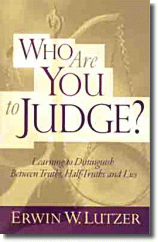
Is doctrine (Theology) important? I think it is! Erwin W. Lutzer (the senior pastor of Moody Memorial Church in Chicago) in his book Who Are You to Judge? (Moody), tells us that doctrine correctness is important. We shouldn't "sacrifice" truth for love. On the contrary, we have the responsibility to judge doctrine when they are wrong. We judge doctrine, judge behaviour, but we do not judge people! God does that! Dr. Lutzer reminds us that we must have biblical discernment. Among the notable statements that Dr. Lutzer made, one of them is A half-truth is more destructive than a whole lie, namely because a half truth is harder to recognize. If we just look around, this is exactly what is happening in many of the "mega" churches around us (in Singapore). These churches talk about Jesus, but they add a lot of other consumer-oriented "biblical truths". We mustn't let misguided tolerance plagues our church. Marsha West has written a two-part commentary titled “Whatever” Christianity (Part I, Part II) that laments the theological relativism commonly seen in many Christians. She pointed out that to post-modern Christians, even outright heresy becomes acceptable. Hmm... , it seems we have really forgotten we are warned that "Beware of false prophets, who come to you in sheep's clothing but inwardly are ravenous wolves. (Matthew 7:15)
But didn't Jesus say "Who are you to judge?" "Do not judge or you to will be judged." When using these statements, many of us didn't exactly know what we meant. Defective hermeneutics is the cause! We take bible verses out of context. Jesus is only telling us "Don't become a Pharisee, but do make righteous judgments. " For me, I don't see one as unloving when he/she judges. We just need to learn discernment in a loving way. That is, when one is exposing error, one should do it with an intent to win back the brother. May we not lost the ability to judge the world because we have lost the ability to judge ourselves!
Doctrinal purity is important. If we (the church) is not correct in our doctrine, we run into the danger of preaching a false gospel, and a false gospel is not relevant to the world!
I believe there can be a balance of doctrinal correctness and a love for Christ. There is simply no clash! When we love God, we will be concerned about doctrinal correctness. When we know what is really "doctrinal correctness ", we learn to love God. We see the need and importance of loving God, because we know that Jesus Christ is the first Word. Jesus is the Word behind the words of Scripture. As Schleiermacher tells us, true religion is “an immediate relation to the living God, as distinct from submission to doctrinal or creedal propositions about God.”
Dr McGrath tells us that "many of Eliot’s misgivings about Christianity in general are best seen as specific response to the ideas of evangelicalism". For example, in an article in the Westminster Review for October 1855, Eliot offered a sustained criticism of a popular London evangelical preacher, John Cumming. Eliot took particular exception to Cumming’s insistence that only actions directed toward the glory of God might be deemed to be good. Eliot wrote:
Dr McGrath wrote that Eliot deems this to be a rather harsh and unattractive God, who “instead of sharing and aiding our human sympathies is directly in collision with them; who instead of strengthening the bond between man and man, by encouraging the sense that they are both alike the objects of His love and care, thrusts himself between them and forbids them to feel for each other except as they have relation to Him.” (p. 130)
In other words, Eliot rejected Christianity because she did not want to believe in an idea of a sovereign God who could deal unaccountably with his creatures in any way he liked. As McGrath wrote, "many Victorians found this deeply disturbing and in open conflict with their increasingly developed sense of morality and justice". (p. 131) In many ways, contemporary Christians are like Eliot. We reject Christianity, we reject the bible, simply because the truths taught in the bible do not match our expectations. We believe we are more moral and have more justice than God! We believe we can be good without God! However, these beliefs just show we have entered postmodernism---there are no rights or wrongs; truth is defined as my personnel opinion, with no absolutes. We have forgotten (or have we ever believed?) the bible is God's revelation. We are currently in Dec, and this is the month where there are many baptism and confirmation. Those baptised are asked whether they believe in the canon of scripture. many answered "Yes!", but I do wonder how many really meant what they say! We need to be constantly reminded (it seems to me!) that the biblet is 1) Apostolic (authored by immediate apostles or close associates of the apostles. 2) Catholic (widely circulated among the early Christian assemblies. 3) Orthodox (does not contradict the faith of the early Christian tradition) Lastly, most importantly, there is also the Witness of the Holy Spirit. As such, faith in God and trusting the bible as God's revelation is not just a leap of faith. It has historical backings!
While doctrinal correctness is important, we mustn't forget that "The love within the church attracts the world, the holiness within the church convicts the world." We should never think "It is better to tolerate error than to look ugly defending the truth"! Also, if we are no longer loving, it just shows that we have not understood our bible at all! We may say that we know and believe in God (ie. know doctrines), but we do not. May God grant us a loving heart and a discerning mind! Amen!
While earlier forms of evangelicalism had been theologically generous, laying emphasis upon personal devotion to Jesus rather than fidelity to theological dogmas, a new stridency within the movement around this time led to a hardening of attitudes. The quality of a person’s faith was now judged by doctrinal correctness rather than a love for Christ. The warmheartedness of earlier versions of evangelicalism now gave way to increasingly dogmatic and impersonal construals of the Christian faith, which repelled as many as it attracted. (p. 128)
Is doctrine (Theology) important? I think it is! Erwin W. Lutzer (the senior pastor of Moody Memorial Church in Chicago) in his book Who Are You to Judge? (Moody), tells us that doctrine correctness is important. We shouldn't "sacrifice" truth for love. On the contrary, we have the responsibility to judge doctrine when they are wrong. We judge doctrine, judge behaviour, but we do not judge people! God does that! Dr. Lutzer reminds us that we must have biblical discernment. Among the notable statements that Dr. Lutzer made, one of them is A half-truth is more destructive than a whole lie, namely because a half truth is harder to recognize. If we just look around, this is exactly what is happening in many of the "mega" churches around us (in Singapore). These churches talk about Jesus, but they add a lot of other consumer-oriented "biblical truths". We mustn't let misguided tolerance plagues our church. Marsha West has written a two-part commentary titled “Whatever” Christianity (Part I, Part II) that laments the theological relativism commonly seen in many Christians. She pointed out that to post-modern Christians, even outright heresy becomes acceptable. Hmm... , it seems we have really forgotten we are warned that "Beware of false prophets, who come to you in sheep's clothing but inwardly are ravenous wolves. (Matthew 7:15)
But didn't Jesus say "Who are you to judge?" "Do not judge or you to will be judged." When using these statements, many of us didn't exactly know what we meant. Defective hermeneutics is the cause! We take bible verses out of context. Jesus is only telling us "Don't become a Pharisee, but do make righteous judgments. " For me, I don't see one as unloving when he/she judges. We just need to learn discernment in a loving way. That is, when one is exposing error, one should do it with an intent to win back the brother. May we not lost the ability to judge the world because we have lost the ability to judge ourselves!
Doctrinal purity is important. If we (the church) is not correct in our doctrine, we run into the danger of preaching a false gospel, and a false gospel is not relevant to the world!
I believe there can be a balance of doctrinal correctness and a love for Christ. There is simply no clash! When we love God, we will be concerned about doctrinal correctness. When we know what is really "doctrinal correctness ", we learn to love God. We see the need and importance of loving God, because we know that Jesus Christ is the first Word. Jesus is the Word behind the words of Scripture. As Schleiermacher tells us, true religion is “an immediate relation to the living God, as distinct from submission to doctrinal or creedal propositions about God.”
Dr McGrath tells us that "many of Eliot’s misgivings about Christianity in general are best seen as specific response to the ideas of evangelicalism". For example, in an article in the Westminster Review for October 1855, Eliot offered a sustained criticism of a popular London evangelical preacher, John Cumming. Eliot took particular exception to Cumming’s insistence that only actions directed toward the glory of God might be deemed to be good. Eliot wrote:
Dr Cumming’s theory … is that actions are good or evil according as they are prompted or not prompted by an exclusive reference to the “glory of God.” God, then, in Dr Cumming’s conception, is a being who had no pleasure in the exercise of love and truthfulness and justice, considered as effecting the well-being of His creatures; he has satisfaction in us only so far as we exhaust our motives and dispositions of all relation to our fellow-beings, and replace sympathy with men by anxiety for the “glory of God.” (p. 130)
Dr McGrath wrote that Eliot deems this to be a rather harsh and unattractive God, who “instead of sharing and aiding our human sympathies is directly in collision with them; who instead of strengthening the bond between man and man, by encouraging the sense that they are both alike the objects of His love and care, thrusts himself between them and forbids them to feel for each other except as they have relation to Him.” (p. 130)
In other words, Eliot rejected Christianity because she did not want to believe in an idea of a sovereign God who could deal unaccountably with his creatures in any way he liked. As McGrath wrote, "many Victorians found this deeply disturbing and in open conflict with their increasingly developed sense of morality and justice". (p. 131) In many ways, contemporary Christians are like Eliot. We reject Christianity, we reject the bible, simply because the truths taught in the bible do not match our expectations. We believe we are more moral and have more justice than God! We believe we can be good without God! However, these beliefs just show we have entered postmodernism---there are no rights or wrongs; truth is defined as my personnel opinion, with no absolutes. We have forgotten (or have we ever believed?) the bible is God's revelation. We are currently in Dec, and this is the month where there are many baptism and confirmation. Those baptised are asked whether they believe in the canon of scripture. many answered "Yes!", but I do wonder how many really meant what they say! We need to be constantly reminded (it seems to me!) that the biblet is 1) Apostolic (authored by immediate apostles or close associates of the apostles. 2) Catholic (widely circulated among the early Christian assemblies. 3) Orthodox (does not contradict the faith of the early Christian tradition) Lastly, most importantly, there is also the Witness of the Holy Spirit. As such, faith in God and trusting the bible as God's revelation is not just a leap of faith. It has historical backings!
While doctrinal correctness is important, we mustn't forget that "The love within the church attracts the world, the holiness within the church convicts the world." We should never think "It is better to tolerate error than to look ugly defending the truth"! Also, if we are no longer loving, it just shows that we have not understood our bible at all! We may say that we know and believe in God (ie. know doctrines), but we do not. May God grant us a loving heart and a discerning mind! Amen!
Friday, December 01, 2006
Church Repels?
I am currently reading Alister McGrath's The Twilight of Atheism: The Rise and Fall of Disbelief in the Modern World. In church, we, too often, feel the coldness (rather than warmness) of the members. Is it because of nominalism, unregenerate Spirit, or we have simply forgotten and chosen to ignore the our Lord's admonition that we must love our neighbours as ourselves. Anyway, I think the only solution we have is to pray... ... in the hope that history doesn't repeat itself!
Paradoxically, history strongly suggests that those who are attracted to atheism are first repelled by theism. What propels people toward atheism is above all a sense of revulsion against the excess and failures of organized religion. Atheism is ultimately a worldview of fear –a fear, often merited, of what might happen if religious maniacs were to take over the world. The existence and appeal of atheism in the West is thus largely derivative, mirroring the failings of the churches and specific ways of conceiving the Christian faith. ---(Alister McGrath. The Twilight of Atheism: The Rise and Fall of Disbelief in the Modern World. p. 274)
Sunday, November 19, 2006
For whom did God die?
For whom did God die?
In my previous blog entry, I reflected on John 3:16 and its implication on the extent of Christ's work on the Cross.This blog will continue with the question of ‘for whom did God die’ still exists. For the Arminians, redemption is universal in scope (because God loves everyone) but not effective for every person (because not everyone responded with faith). For the Calvinist, redemption is particular in scope (because not everyone is chosen/elected), but always effective for the elect. The Arminians accused Calvinists that they are not fair, they say Calvinist attempt to limit God’s atonement. However, upon closer examination, one can see that their accusation has not been fair or accurate. Calvinists are not trying to make God look bad. Just as there is no contradiction between a loving God and the reality of hell, there is no contradiction between a loving God and the doctrine of election.
Firstly, if the redemption is universal in scope but not effective for every person (since Arminians believe we can reject salvation), the Arminians are also placing a limit on God’s atonement. There is no difference on the number of people saved, despite the Arminians’ claim to liberality. For the Arminians, it is Man choose God; for the Calvinist, it is God choose Man. From John 3:16 “that whoever believes in Him shall not perish”, it is also obvious that not everyone would be saved. Though the Arminian emphasized free will, the Calvinist’s view of irresistible grace is much more gracious than the Arminian’s belief of freewill salvation.
Secondly, “that whoever believes in Him shall not perish” (John 3:16) tells us that the gospel is to be preached to everyone. We should remind ourselves that election is not "information" from which we are to decide whether or not to respond to God in faith, or worry whether or not we are elect, or use as an excuse if we decide we are reprobate. Rather, it is the Gospel, the Good News that God has chosen to make salvation available in Christ by faith to all who respond and that ultimately we need not depend upon our own resources (since they are never sufficient) but upon the grace of God alone. How can one say that God is unfair when one cannot be sure that God did not elect him/her? If one thinks that God is unfair, they can believe in the Gospel and persevere!
Thirdly, there is the question of infant baptism. I believe that infant baptism supports the biblical view of election (thus particular atonement) based on God’s grace and divine sovereignty. The practice the baptism of infants in many of the Protestant Churches shows that John 3:16 “For God so loved the world” is not untrue as God saves the elect (such as infant) even before he can believe. Methodists (Wesleyans & Arminians) believe that God elect based on foreknowledge that the person will believe, but what if the infant are not able to live to an age (maybe to accidents or illnesses) where he can believe? Under the Arminian theological framework, how does God treat these cases? For the Calvinist (Presbyterians & Reformed Churches), the practice the baptism of infants does not face this problem since an infant is saved because it is based on God’s election and covenantal promise.
However, Methodists in Singapore practice infant baptism, as it is seen as ‘a sign of the child's belonging to the Church of God’1. Methodists in Singapore believed that:
It is the grace of God which even enables the believer to repent and receive God's grace. It is the grace that enables the believer to repent and receive God's grace. It is the grace that enables the believer to grow in faith and in doing God's will. [See A Methodist view of the Sacraments and Observances, Section on ‘Holy Baptism’ at http://www.trac-mcs.org.sg/discipleship/ms1.htm. Emphasis is bold is mine]
Thus, it seems that local Methodists’ view is much closer to the Calvinist (at least on paper!); they believe that infants (& all elected) are still saved because of God’s grace and sovereignty, and not because of God’s foreknowledge that we (including infants) would believe.
In his Institutes, Turretin distinguishes between those who have "the saving habit of acting faith" (or "actual faith") and those who have faith in its "principle and root," which an infant can possess since he "can have the Holy Spirit, with which to believe in his own time" (Institutes 19.20.19). Likewise, Junius says, "regarding the species of faith, it is to be considered both with regard to its first act and (as they say) its second." Infants are capable of faith as it in its first act and thus "it false to argue that infants are completely incapable of faith," though this is "God's secret and hidden thing" (Theses Theologicae 51.7). Johann Heinrich Alsted (1588-1638) similarly maintains that while infants may be "destitute of what is called 'actual faith', they are not on that account destitute of all faith...Faith in principle and seed, and virtually, is to be attributed to elect infants" (Theologia, Scholastica Didactica, 785).
The example of David’s situation in the OT clearly shows this. When his infant child died, David is given the confidence that he will see that child again in heaven. This story of David and dying child gives a tremendous consolation to parents who have lost infants to death. From David’s strong belief, it can also be seen that it is not by the infants’ innocence but by God’s grace that they are received into heaven. We come into this world with a sin nature, and so the baby that dies, dies as a sinful child. And when that child is received into heaven, he is received by grace. If a child is elected, he would surely be saved.
1 The Articles of Religion in the "Methodist Discipline" (1976, para 17) clearly state: "The baptism of young children is to be retained in the church." The objective work of God is available to infants. The child is initiated into the Body of Christ in a spiritual manner. An infant who is baptized has the parents or others as sponsors or godparents. At the baptism service they hold themselves responsible for safeguarding the welfare of the child, especially in its spiritual nurture. The congregation itself is held responsible for the Christian nurture of the child. The baptized child is enrolled as a preparatory member of the church. Infant baptism is:
-
a dedication of the child to God
-
a pledge of the parents and others to carry out their duties in the child's Christian nurture.
-
a sign of the child's belonging to the Church of God
-
a mark (seal) of the Holy Spirit's work in the child.
In every baptism there is the establishment of a mystical union of the baptized person with Christ. Here again it is an act of faith that God can do more than we expect through His grace and might. (Mark 10:13-16). [Source: A Methodist view of the Sacraments and Observances, http://www.trac-mcs.org.sg/discipleship/ms1.htm]
Tuesday, November 14, 2006
Reflection on John 3:16
Most Christians believe that God sent his Son to save us. If we believe in him (John 3) through faith [1], we would be saved. But on the point of ‘for whom is the redemption applied to’, there is some disagreement. This is not without reason. In the bible, there seem to be various verses that teach a universal reference for the saving work of Jesus Christ (John 12:32; Rom 3:22-24; 5:18; 8:32; I Cor. 15:22; 2 Cor. 5:14-15; I Tim. 2:5-6; Tit. 2:11; Heb. 2:9) or a universal saving will on God’s part (Rom. 11:32; 1 Tim 2:4; 2 Pet. 3:9).(Dr Robert Reymond’s A New Systematic Theology of the Christian Faith [ANSTCF], p. 685)
So, for whom did God die? Maybe it will be good to start examining this issue by turning to biblical passages, and beginning with our most familiar passage, John chapter 3, focusing especially on verse 16.
John 3:10-20 (New International Version)
10"You are Israel's teacher," said Jesus, "and do you not understand these things? 11 I tell you the truth, we speak of what we know, and we testify to what we have seen, but still you people do not accept our testimony. 12I have spoken to you of earthly things and you do not believe; how then will you believe if I speak of heavenly things? 13No one has ever gone into heaven except the one who came from heaven—the Son of Man. 14Just as Moses lifted up the snake in the desert, so the Son of Man must be lifted up, 15that everyone who believes in him may have eternal life.
16"For God so loved the world that he gave his one and only Son, that whoever believes in him shall not perish but have eternal life. 17 For God did not send his Son into the world to condemn the world, but to save the world through him. 18Whoever believes in him is not condemned, but whoever does not believe stands condemned already because he has not believed in the name of God's one and only Son. 19This is the verdict: Light has come into the world, but men loved darkness instead of light because their deeds were evil. 20Everyone who does evil hates the light, and will not come into the light for fear that his deeds will be exposed.
John 3:16
The word ‘world’ quite likely has the same meaning as in I John 2:15. Warfield, for example, commented that:
[The term “world”] is not here a term of extension as much as a term of intensity. Its primary connotation is ethical, and the point of its employment is not to suggest that the world is so big that it takes a great deal of love to embrace it all, but that the word is so bad that it takes a great kind of love to love it all, and much more to love it as God has loved it when he gave his son for it. … The passage was not intended to teach, and certainly does not teach, that God loves all men alike and visits each and everyone alike with the same manifestation of love: and as little was intended to teach or does it teach that his love is confined to a few especially chosen individuals selected out of the world. What it is intended to do is to arouse in our hearts a wondering sense of the marvel and mystery of the love of God for the sinful world –conceived here, not quantitative but qualitatively as, in its very distinguishing characteristic, sinful. [See B B Warfield, “God’s Immeasurable Love,” in Biblical and Theological Studies (Philadelphia: Presbyterian and Reformed, 1952), p. 516, emphasis in bold is mine]
Indeed, the “wondering sense of the marvel and mystery of the love of God for the sinful world” is stressed in chapters 13-17 of the John Gospel. As Dr D A Carson wrote:
Both the verb ‘to love’ (agapaō) and the noun ‘love’ (agapē) occur much more frequently in chs. 13-17 than anywhere else in the Fourth Gospel, reflecting the fact that John devotes special attention to the love relationships amongst the Father, the Son and the disciples. (PNTC, 1991, p. 204)
Warfield is not alone in this interpretation. John Gill, an eminent 18th century Baptist theologian, in his commentary on John, wrote: “Not every man in the world is here meant, or all the individuals of human nature; for all are not the objects of God’s special love, which is here designed.” Therefore, it is most likely Warfield is correct in saying that "world" in John 3:16 means "sinner"—without stating which ones. It seems that the "world" in John 3:16 is not to teach ‘election’ or ‘universal redemption’. John 3:16 would be analogous to Rom. 5:6 (‘For while we were still weak, at the right time Christ died for the ungodly.’) where Paul states that Christ died for the "ungodly"—without stating which ones.
The “For God so loved the world” in John 3:16 show that God loves both the elect and the non-elect. There is no doubt on this, since other bible passages (both OT & NT) support this. In the OT, for example, we have Psalm 145:9: “The Lord is good to all, and his mercy is over all that he has made.” In the NT, we have Luke 6:35 (“he is kind to the ungrateful and the evil”). Here, God teaches us love our enemies for even God himself loves all (includes the elect).
How do we define the “world” (cosmos) in John 3:16? The general redemption view assumes that this word must refer to each and every person that ever lived. However, this is not the biblical meaning. The BAGD defines “cosmos” in John 3:16 as referencing “all mankind, but especially of believers, as the objects of God’s love.” This, however, is a theological interpretation. From TDNT (vol. 3) and BAGD (pp. 446-447), it is clear that in the entire NT, there is no instances of cosmos referring to every single person who has ever lived.
How do we explain “For God so loved the world” in John 3:16? NT scholar Dr D A Carson pointed out that:
Because John 3:16 is sandwiched between vv.14-15 and v. 17, the fact that God gave his one and only Son is tied both to the Son’s incarnation (v. 17) and to his death (vv. 14-15). That is the immediate result of the love of God for the world: the mission of the Son. His ultimate purpose is the salvation of those in the world who believes in him […] (PNTC, p. 206, italics mine)
Indeed, if we were to look at the surrounding verses of John 3:16 (NASB), we see the repeated occurrence of the word ‘believe’ and ‘Son of God’:
v. 12: "If I told you earthly things and you do not believe, how will you believe if I tell you heavenly things?
v.13: " No one has ascended into heaven, but He who descended from heaven: the Son of Man.
v.14: "As Moses lifted up the serpent in the wilderness, even so must the Son of Man be lifted up;
v.15: so that whoever believes will in Him have eternal life.
v. 16: "For God so loved the world, that He gave His only begotten Son, that whoever believes in Him shall not perish, but have eternal life.
v. 17: "For God did not send the Son into the world to judge the world, but that the world might be saved through Him.
v. 18: "He who believes in Him is not judged; he who does not believe has been judged already, because he has not believed in the name of the only begotten Son of God.
In 7 verses (btw John 3: 12-18), the word ‘believe’ occurs 5 times and ‘Son of God’ (or ‘Son’) occurs 5 times. Though it seems much fairer to say God want to save everyone, the bible clearly shows that the ones who are saved (John 3:3,5, 15,16,17) are only those who “believes in him” (John 3:15, 16,18) and not everyone.
John 3:15-18 (NIV):
15that everyone who believes in him may have eternal life.16"For God so loved the world that he gave his one and only Son, that whoever believes in him shall not perish but have eternal life. 17 For God did not send his Son into the world to condemn the world, but to save the world through him. 18Whoever believes in him is not condemned, but whoever does not believe stands condemned already because he has not believed in the name of God's one and only Son.
John 3:15-18 (NASB):
15 so that whoever believes will in Him have eternal life. 16"For God so loved the world, that He gave His only begotten Son, that whoever believes in Him shall not perish, but have eternal life. 17"For God did not send the Son into the world to judge the world, but that the world might be saved through Him. 18"He who believes in Him is not judged; he who does not believe has been judged already, because he has not believed in the name of the only begotten Son of God.
As a conclusion, it can be seen that at the Synod of Dort, Calvinists is right to affirm that Christ’s death is sufficient for all but efficient only for the elect.
[1] There are 3 elements of faith: knowledge (the intellectual element; Mind), assent (the emotional element; Heart) and trust (the voluntary/volitional element; Will).
Friday, November 10, 2006
Is God really bad?
Atheist Thomas Jefferson described God as “cruel, vindictive, capricious and unjust.” (cited in George Smith, Atheism: The Case Against God. Amherst, NY: Prometheus Books, 1989, pp. 76-78.) Jefferson cited Isaiah 45:7, where God says “I form light and create darkness, I make well-being and create calamity, I am the Lord, who does all these things.”(ESV)
However, in this verse, the Hebrew word for “calamity” (ESV) or “disaster” (NIV) does not mean “moral evil.” In fact, Hebrew linguist tell us that the word need not have any moral connotations at all. The ESV seems more accurate as this word would be perfectly fitting for the plagues that God inflicted on the Egyptians through Moses. These plagues involved not moral evil but rather calamitous events engineered to bring the Egyptians to repentance. God as judge of the earth can rightly inflict such plagues on sinful human beings without having his character impugned with accusations of evil. Certainly such plagues may seem evil to those experiencing them, but the reality is that these people were experiencing due justice.
If we were to read the bible as a whole (& not out of context), we would understand that God is morally perfect. The bible is clear that God is morally perfect (cf. Deut. 32:4; Matt. 5:48), and it is impossible for him to sin (Heb 6:18). He punish sin because his absolute justice demands that. In the case of the Egyptians, God was merely bringing just justice on unrepentant sinners. God’s good end –the deliverance of the Israelites from Egyptian bondage –was the result of this judgment.
However, in this verse, the Hebrew word for “calamity” (ESV) or “disaster” (NIV) does not mean “moral evil.” In fact, Hebrew linguist tell us that the word need not have any moral connotations at all. The ESV seems more accurate as this word would be perfectly fitting for the plagues that God inflicted on the Egyptians through Moses. These plagues involved not moral evil but rather calamitous events engineered to bring the Egyptians to repentance. God as judge of the earth can rightly inflict such plagues on sinful human beings without having his character impugned with accusations of evil. Certainly such plagues may seem evil to those experiencing them, but the reality is that these people were experiencing due justice.
If we were to read the bible as a whole (& not out of context), we would understand that God is morally perfect. The bible is clear that God is morally perfect (cf. Deut. 32:4; Matt. 5:48), and it is impossible for him to sin (Heb 6:18). He punish sin because his absolute justice demands that. In the case of the Egyptians, God was merely bringing just justice on unrepentant sinners. God’s good end –the deliverance of the Israelites from Egyptian bondage –was the result of this judgment.
Monday, October 02, 2006
Till d.... do we part?
"Till d.... do we part?" If I am given this sentence, and asked to fill in the blank, I think there would be two answers. In the past, it was "Till death do we part." Now it seems that it is "Till divorce do we part" . Marital permanence seems to be a thing of the past!
At the Channel NewsAsia website More marriages, more divorces last year (25 Sept 2006), it was reported that "Even as more people are getting married, divorces have also been on the rise." According to the report, 8.16 percent more marriages ended in divorce in 2005 than in 2004. The number of divorces rose to 6,909 in 2005 from 6,388 a year ago. Even more worrying is that "This is also the largest increase in the past decade". The question to ask is why is more people choosing divorce? I think Chares Colson gave a very good answer in his book Lies That Go Unchallenged in Popular Culture (Tyndale), he wrote that:
Another "interesting" point to note is that "younger couples, aged between 20 and 24, registered the highest divorce rate last year". Hmm ... is there something wrong with the values of the younger couples? How do they perceive marriage?
In Charles Colson's book Lies That Go Unchallenged in Popular Culture (Tyndale), he wrote that:
As to why younger couples, aged between 20 and 24, registered the highest divorce rate last year, I think the reason is indeed "Preparation and commitment are seriously lacking". People no longer treat marriage with the 'respect' it use to have.
Many Christians have also forgotten that marriage is a permanent relationship, that it is a life-longcommitment. (Read Gen 1:24 & Matt 19:5-6).
In many cases of divorce, marriage is no longer a covenant or a solemn vow , but only a “contract”. Charles Colson describes this change as a "rhetoric shift", and this has led couples to see marriage as just a voluntary agreement between two adults. As Colson puts it,
"If marriage is a contract, then the parties are free to negotiate the terms of their agreement, enforce those terms, and terminate the agreement whenever they choose. [... ...] If marriage is simply a contract, then it’s impossible to limit the terms of that contract to one man and one woman in a lifelong committed relationship. Instead, anything goes." (p. 86)
If marriage is not a “contract”, what is it? A sacrament? A covenant?
For the Roman Catholics, marriage is a sacrament (officially codified at the Council of Trent). However, this view of marriage as a sacrament is influenced by Augustine's writings (such as his De Bono conjugali ["On the Good of Marriage"]). However, this view has its defects. One defect is that the bible does not say that the institution of marriage dispenses divine grace.
For Christians, marriage is a covenant, not just a contract or a piece of paper. Marriage is instituted by God. It is a Christ-ordained institution. We need to rememer the words "we are gathered today in the presence of God and of this witness to unite this man and this woman in the holy bonds of marriage...". We are also told "Be ye not unequally yoked together with unbelievers" (2 Corinthians 6:14). In the Old Testament tradition, the children of Israel were called to seek eives from their own nation, that is people of the same religious persuasion. This is why it is sometimes so difficult for us Christians to explain to our friends (mostly non chirstian) why christians should not date non christains (vice versa) be it guys or gals. Non-Christians feel we are just narrow minded with such a thinking.
There are a few points which I think may the reason as to why christians should not date (or marry) non-Christains:
1) Prayer Life: You cannot pray with him/her, he/she cannot pray for you
2) Spiritual Growth: You cannot achieve spiritual intimacy with God together.
3) Serving the Lord: You cannot serve God with him/her, he/she cannot understand why you obey God, and there will be conflicts.
4) Perservering Together: The person you date MUST have fervent and reverence for God and obedience as well. Then can the Holy Spirit work out well in both to forgive, rebuke with love, build each other up, and grow together.
For Non-Christians, marriage is not a covenant or a solemn vow , but only a “contract” (which is the prevailing secular view. Everything we choose is a matter of choice!). The view that marriage is a contract has its root in the civil law, which sees marraige as a contract that is bilateral, voluntarily formed, maintained, and dissolved by two individuals.The source of this thinking can be traced back to the medieval ecclesiastical courts and Enlightenment thinking. Firstly, we know that marriage is thus not just between me and my girlfriend/boyfriend, but between me, my girlfriend/boyfriend, and God. It is not simply a bilateral but a trilateral relationship. Secondly, we forget that marriage is a divine institution. We thought that it is just our own private choice! Thus, we cannot marriage cannot be voluntarily formed, maintained, and dissolved by two individuals. In a sense (biblical), we are not free to negotiate the terms of their agreement, enforce those terms, and terminate the agreement whenever we choose. Marraige is regulated by God's commandments. Worringly, it seems that for many Christians, marriage has also ceased to be a covenant or a solemn vow and has instead become a “contract”. This is not surprising when one considers the fact that biblical literacy is dropping. Younger Christians, in general, do not have a good understanding of the biblical doctine of marriage. (Gen 2:18-25)
We should remember that marriage is a covenantal relationship. Though the New Testament writers do not explicitly label marriage as a covenant(though the concept is still present in NT verses such as Matt 19:6//Mark10:9), they do describe it as being similar to a covenant (cf. Eph. 5:22-33). If we turn to Mal 2:14, it speaks of marriage as a covenant: “Yet ye say, Wherefore? Because the LORD hath been witness between thee and the wife of thy youth, against whom thou has dealt treacherously: yet is she thy companion, and the wife of thy covenant.” (KJV) Because marriage is a covenant, witness is needed, and this make marriage vows are significant, and this should be done in a formal ceremony (though it doesn't have to be in church, since marriage is instituted for all people, whether they are Christians or non-Christians), in the presence of witness. Without the witnesses there is no legal covenant, no legal commitment, no formal binding responsibility for one to keep his promises. However, isn't covenant only for commitments between God and Human beings (eg., Noahic, Abrahamic, Mosaic)? Interestingly, the answer is no. It also refers to a variety of agreements between humans (Gen21:22-24; 2 Kings 11:17). When it includes marriage, besides Mal 2:14 stated above, Prov. 2:16-17 and Ezek. 16:8 are also texts we can refer to.
Ezek 16:8 reads:
8"Then I passed by you and saw you, and behold, you were at the time for love; so I spread My skirt over you and covered your nakedness I also swore to you and entered into a covenant with you so that you became Mine," declares the Lord GOD.
To avoid/prevent divorce, what can we do? There are a few things that we mustn't forget. First, we must remember that the home is God’s idea, it is not a human invention or a cultural phenomenon. In the plan of creation God designed the home as the foundation of society, to meet the mental, spiritual, physical, emotional needs of men, women and children.
We need to be reminded that the family is not designed for temporary convenience—to be kept together so long as it’s fun and pleasing. The family’s strength is its permanence. God designed the family as a lasting relationship in which, with His care, humans could weather the storms of life together. The home is God’s loving shelter for growing to maturity.The home is a place for spiritual growth. If one marry a non-Christian, one cannot achieve spiritual intimacy with God together. As such, this intended purpose of the family/home is lost!
Although the family is a lasting relationship, it is not an automatic success. The daily parts and pieces of life just don’t automatically fall into place. Loving and living with your partner and children takes determination and practice, plus time and imagination, sacrifice and planning, and much more.
But love and determination by themselves aren’t enough to build the relationship God intended. God not only designed the home, but He desires to be at the center of family life—guiding, sustaining, filling the home with His love, peace, forgiveness. [...]
As we seek to make Jesus Christ Lord of our life and home, we need to search the Bible daily for guidance in our family life. For God’s instructions to each family member, read Ephesians 5:15-6:4 and Colossians 3:12-21. Prayer is important for evey aspect of our life. Prayer is the steering wheel of our life, it is not a spare tyre. Prayer is the first and key to our Christian life, it is not an option . Thus, we need to pray that God would help us fulfill our family responsibility, realizing that He wants to help our family weave our lives into one harmonious design.
If we are from a Christian family, we need to encourage our family to begin a time of daily prayer and Bible study. As our family shares praise and personal needs in prayer and searches God’s Word, we will be growing closer to the Lord and to each other.
Equally important, we should attend a Bible-believing church (non-liberal! With faithful, systematic expository preaching of biblical texts.) together with our spouse (and even father, mother, sister, brother... I like the concept of a "Family Service" where different generations of a Christian family worship together. Age-specific worship Service, such as Youth Worship, may be more purpose-directed and able to attract more members, but I doubt this would the method we would be worshipping God in "heaven"!), so that we may find the encouragement and fellowship of other Christians, and instruction in God’s Word.
With Christ as Lord of our family, we can have a happy home. As we daily yield to Him, our home will be filled with God’s love and wisdom. Our home will be more than just a place. It will be a family—living, growing, learning and creating together with God. (Source: Tract Text, How to Have a Happy Home, by Good News Publisher)
To gain a better perspective on what the bible says about marriage and family, one excellent book is Andreas J Kostenberger's boook God, Marriage, and Family: Rebuilding the Biblical Foundation (Crossway, 2004). This is a must-read! Besides giving us a biblical perspective on what the bible says about divorce and remarriage, it also covers issues such as childrearing, singleness, and homosexuality. I am also aware of Geoffrey Bromiley's God and Marriage. It seems to be also a good book, but I have not had the chance to read it! As it is a bit dated, many of challenges facing the contemporary family are not dealt with in this book.
Though the bible may not be clear on every family issues we can think of, it definitely provides guidelines. However, we need to read the bible ourselves. For many of the times, there is no fast solutions to our daily problems or easy-to follow step-by-step formula to our daily choices. For example, in Chris Wright's Old Testament Ethics for the People of God (IVP: May 2004), he wrote that:
1) Carl Laney argues that the Bible indicates that marriages are always intended to be permanent, that there is never a need for divorce and that remarriage is never permissible after divorce.
2) William Heth contends that while there are legitimate biblical grounds for divorce, there are no legitimate grounds for remarriage after divorce.
3) Thomas Edgar defends the position that Scripture allows for divorce and remarriage in cases of adultry or desertion.
4) Larry Richards holds that Scripture, while decrying divorce and the pain it causes, points to a God of grace who will not condemn those who divorce and remarry.
For me, I am for Thomas Edgar 's view. I believe that Scripture allows for divorce and remarriage in cases of adultry, desertion and death of spouse. For this view, I turn to Deut 24, Mal 2:14-16, Mark 10:9, 11-12, Matt19:9, 1 Cor 7:10-39 (esp. v10-11; v12-16; v39). One of the reason the Bible takes a dim view of adultery because it is the supreme act of infideility that breaks the trust and breaks the faith upon which marriage is built. Marriage is a gift from God, but it is regulated by God's commandments. We do not use it however we want to!
What about physical abuse then? Is physical abuse legitimate grounds for divorce? Though abuse within is a dreadful reality, it seems God doesn't include physical abuse as a legitimate ground for divorce. If the physical abuse happens in a Christian home, then there is a need for church discipline (though many of the present-day churches seem more interested in trying to please their members [for more offerings & 'support'!] rather than discipline them!) in order to protect the person who is being abused. If this fails or if people is outside the church, then the use of legal system may be unavoidable! Temporary separation is also possible if the abusing partner refuses to mend their ways. One reason why God did not allow divorce for physical abuse maybe that God sees it as a problem that can be overcome. There are indeed many cases where marriages have been redeemed after people have repented and overcome their destructive patterns of behaviour.
In a marriage, as in the relationship between God and us, forgiveness is of utmost importance. When we look to the Creation account, we are reminded of the sanctity of marriage. This is also why Jesus said "But from the beginning it was not so" (Matt. 19:8). Jesus reminds us that the original intention of marriage did not include divorce. So, just as Jesus told the woman taken in adultery who was repentant: “Neither do I condemn thee: go, and sin no more” (John8:10-11), we should be forgiving towards those who truly repents. After all, reconciliation, restoration, and forgiveness are supposed to be the identifiers a true Christian (Luke 11:4; Galatians 5:22-23; Ephesians 4:32). May the 'd....' in "Till d.... do we part?" be 'death' and not' divorce'. May God give those married the strength and the wisdom needed for a lasting marriage.
At the Channel NewsAsia website More marriages, more divorces last year (25 Sept 2006), it was reported that "Even as more people are getting married, divorces have also been on the rise." According to the report, 8.16 percent more marriages ended in divorce in 2005 than in 2004. The number of divorces rose to 6,909 in 2005 from 6,388 a year ago. Even more worrying is that "This is also the largest increase in the past decade". The question to ask is why is more people choosing divorce? I think Chares Colson gave a very good answer in his book Lies That Go Unchallenged in Popular Culture (Tyndale), he wrote that:
When marriage is managed by a marketplace mentality, we view it as a contract instead of as a covenant, making sure that we do only the minimum necessary for our role and that we don’t get cheated out of our rights and privileges. (Colson, p. 87)I beilieved the contempoprary worldview of autonomy and self-centeredness has fuled divorce rate. However, the bible view marriage differently from the postmoderns.
Another "interesting" point to note is that "younger couples, aged between 20 and 24, registered the highest divorce rate last year". Hmm ... is there something wrong with the values of the younger couples? How do they perceive marriage?
In Charles Colson's book Lies That Go Unchallenged in Popular Culture (Tyndale), he wrote that:
Our country has reached a state of marital emergency in which marriage is trivalised. Preparation and commitment are seriously lacking, but government and church now have an opportunity to revive and support the institution. (Colson, p. 59)Though Colson's book was written in the context of the US, it seems what is happening in the US is also happening here in Singpore. ... marriage is trivalised.
As to why younger couples, aged between 20 and 24, registered the highest divorce rate last year, I think the reason is indeed "Preparation and commitment are seriously lacking". People no longer treat marriage with the 'respect' it use to have.
Many Christians have also forgotten that marriage is a permanent relationship, that it is a life-longcommitment. (Read Gen 1:24 & Matt 19:5-6).
In many cases of divorce, marriage is no longer a covenant or a solemn vow , but only a “contract”. Charles Colson describes this change as a "rhetoric shift", and this has led couples to see marriage as just a voluntary agreement between two adults. As Colson puts it,
"If marriage is a contract, then the parties are free to negotiate the terms of their agreement, enforce those terms, and terminate the agreement whenever they choose. [... ...] If marriage is simply a contract, then it’s impossible to limit the terms of that contract to one man and one woman in a lifelong committed relationship. Instead, anything goes." (p. 86)
If marriage is not a “contract”, what is it? A sacrament? A covenant?
For the Roman Catholics, marriage is a sacrament (officially codified at the Council of Trent). However, this view of marriage as a sacrament is influenced by Augustine's writings (such as his De Bono conjugali ["On the Good of Marriage"]). However, this view has its defects. One defect is that the bible does not say that the institution of marriage dispenses divine grace.
For Christians, marriage is a covenant, not just a contract or a piece of paper. Marriage is instituted by God. It is a Christ-ordained institution. We need to rememer the words "we are gathered today in the presence of God and of this witness to unite this man and this woman in the holy bonds of marriage...". We are also told "Be ye not unequally yoked together with unbelievers" (2 Corinthians 6:14). In the Old Testament tradition, the children of Israel were called to seek eives from their own nation, that is people of the same religious persuasion. This is why it is sometimes so difficult for us Christians to explain to our friends (mostly non chirstian) why christians should not date non christains (vice versa) be it guys or gals. Non-Christians feel we are just narrow minded with such a thinking.
There are a few points which I think may the reason as to why christians should not date (or marry) non-Christains:
1) Prayer Life: You cannot pray with him/her, he/she cannot pray for you
2) Spiritual Growth: You cannot achieve spiritual intimacy with God together.
3) Serving the Lord: You cannot serve God with him/her, he/she cannot understand why you obey God, and there will be conflicts.
4) Perservering Together: The person you date MUST have fervent and reverence for God and obedience as well. Then can the Holy Spirit work out well in both to forgive, rebuke with love, build each other up, and grow together.
For Non-Christians, marriage is not a covenant or a solemn vow , but only a “contract” (which is the prevailing secular view. Everything we choose is a matter of choice!). The view that marriage is a contract has its root in the civil law, which sees marraige as a contract that is bilateral, voluntarily formed, maintained, and dissolved by two individuals.The source of this thinking can be traced back to the medieval ecclesiastical courts and Enlightenment thinking. Firstly, we know that marriage is thus not just between me and my girlfriend/boyfriend, but between me, my girlfriend/boyfriend, and God. It is not simply a bilateral but a trilateral relationship. Secondly, we forget that marriage is a divine institution. We thought that it is just our own private choice! Thus, we cannot marriage cannot be voluntarily formed, maintained, and dissolved by two individuals. In a sense (biblical), we are not free to negotiate the terms of their agreement, enforce those terms, and terminate the agreement whenever we choose. Marraige is regulated by God's commandments. Worringly, it seems that for many Christians, marriage has also ceased to be a covenant or a solemn vow and has instead become a “contract”. This is not surprising when one considers the fact that biblical literacy is dropping. Younger Christians, in general, do not have a good understanding of the biblical doctine of marriage. (Gen 2:18-25)
We should remember that marriage is a covenantal relationship. Though the New Testament writers do not explicitly label marriage as a covenant(though the concept is still present in NT verses such as Matt 19:6//Mark10:9), they do describe it as being similar to a covenant (cf. Eph. 5:22-33). If we turn to Mal 2:14, it speaks of marriage as a covenant: “Yet ye say, Wherefore? Because the LORD hath been witness between thee and the wife of thy youth, against whom thou has dealt treacherously: yet is she thy companion, and the wife of thy covenant.” (KJV) Because marriage is a covenant, witness is needed, and this make marriage vows are significant, and this should be done in a formal ceremony (though it doesn't have to be in church, since marriage is instituted for all people, whether they are Christians or non-Christians), in the presence of witness. Without the witnesses there is no legal covenant, no legal commitment, no formal binding responsibility for one to keep his promises. However, isn't covenant only for commitments between God and Human beings (eg., Noahic, Abrahamic, Mosaic)? Interestingly, the answer is no. It also refers to a variety of agreements between humans (Gen21:22-24; 2 Kings 11:17). When it includes marriage, besides Mal 2:14 stated above, Prov. 2:16-17 and Ezek. 16:8 are also texts we can refer to.
Ezek 16:8 reads:
8"Then I passed by you and saw you, and behold, you were at the time for love; so I spread My skirt over you and covered your nakedness I also swore to you and entered into a covenant with you so that you became Mine," declares the Lord GOD.
To avoid/prevent divorce, what can we do? There are a few things that we mustn't forget. First, we must remember that the home is God’s idea, it is not a human invention or a cultural phenomenon. In the plan of creation God designed the home as the foundation of society, to meet the mental, spiritual, physical, emotional needs of men, women and children.
We need to be reminded that the family is not designed for temporary convenience—to be kept together so long as it’s fun and pleasing. The family’s strength is its permanence. God designed the family as a lasting relationship in which, with His care, humans could weather the storms of life together. The home is God’s loving shelter for growing to maturity.The home is a place for spiritual growth. If one marry a non-Christian, one cannot achieve spiritual intimacy with God together. As such, this intended purpose of the family/home is lost!
Although the family is a lasting relationship, it is not an automatic success. The daily parts and pieces of life just don’t automatically fall into place. Loving and living with your partner and children takes determination and practice, plus time and imagination, sacrifice and planning, and much more.
But love and determination by themselves aren’t enough to build the relationship God intended. God not only designed the home, but He desires to be at the center of family life—guiding, sustaining, filling the home with His love, peace, forgiveness. [...]
As we seek to make Jesus Christ Lord of our life and home, we need to search the Bible daily for guidance in our family life. For God’s instructions to each family member, read Ephesians 5:15-6:4 and Colossians 3:12-21. Prayer is important for evey aspect of our life. Prayer is the steering wheel of our life, it is not a spare tyre. Prayer is the first and key to our Christian life, it is not an option . Thus, we need to pray that God would help us fulfill our family responsibility, realizing that He wants to help our family weave our lives into one harmonious design.
If we are from a Christian family, we need to encourage our family to begin a time of daily prayer and Bible study. As our family shares praise and personal needs in prayer and searches God’s Word, we will be growing closer to the Lord and to each other.
Equally important, we should attend a Bible-believing church (non-liberal! With faithful, systematic expository preaching of biblical texts.) together with our spouse (and even father, mother, sister, brother... I like the concept of a "Family Service" where different generations of a Christian family worship together. Age-specific worship Service, such as Youth Worship, may be more purpose-directed and able to attract more members, but I doubt this would the method we would be worshipping God in "heaven"!), so that we may find the encouragement and fellowship of other Christians, and instruction in God’s Word.
With Christ as Lord of our family, we can have a happy home. As we daily yield to Him, our home will be filled with God’s love and wisdom. Our home will be more than just a place. It will be a family—living, growing, learning and creating together with God. (Source: Tract Text, How to Have a Happy Home, by Good News Publisher)
To gain a better perspective on what the bible says about marriage and family, one excellent book is Andreas J Kostenberger's boook God, Marriage, and Family: Rebuilding the Biblical Foundation (Crossway, 2004). This is a must-read! Besides giving us a biblical perspective on what the bible says about divorce and remarriage, it also covers issues such as childrearing, singleness, and homosexuality. I am also aware of Geoffrey Bromiley's God and Marriage. It seems to be also a good book, but I have not had the chance to read it! As it is a bit dated, many of challenges facing the contemporary family are not dealt with in this book.
Though the bible may not be clear on every family issues we can think of, it definitely provides guidelines. However, we need to read the bible ourselves. For many of the times, there is no fast solutions to our daily problems or easy-to follow step-by-step formula to our daily choices. For example, in Chris Wright's Old Testament Ethics for the People of God (IVP: May 2004), he wrote that:
The authority of the Scripture is that which authorizes us to develop our ethical stances, policy choices and decision-making in new contexts not directly addressed by the Bible. The authority of the Old Testament for ethics does not pre-define every choice we have to make. But the more sharply we can articulate the very particularity of Israel, and understand the reasons for the laws they had, the more confident we can be in making ethical choices which are ‘authorized' – that is, that are legitimate within the contours and limits of the paradigm God has given us. [More] [Rev. Chris Wright is the International Ministries Director for Langham Partnership International ]Back to the question of "Can Christians divorce?". This is not a new question. In Matthew's Gospel, ofr example, the Pharisees come to Jesus, and asked, "Is it lawful to put away one's wife in the case of infidelity?" [We know that the Pharisees are trying to trick Jesus into speaking against the law of Moses.] On the very surface, the answer seems to be a 'no', but we know that not every Christians agrees on how we should understand what the Bible says about divorce and remarriage. The answer is also not a simplistic 'yes' or 'no'. For example, if one were to go to a Christian bookstore and look on the bookselves, there are 'tons' of books on this issue. One particular book which caught my attention was Divorce and Remarriage (IVP, edited by H Wayne House). In this book, four authors present their distinct perspectives.
1) Carl Laney argues that the Bible indicates that marriages are always intended to be permanent, that there is never a need for divorce and that remarriage is never permissible after divorce.
2) William Heth contends that while there are legitimate biblical grounds for divorce, there are no legitimate grounds for remarriage after divorce.
3) Thomas Edgar defends the position that Scripture allows for divorce and remarriage in cases of adultry or desertion.
4) Larry Richards holds that Scripture, while decrying divorce and the pain it causes, points to a God of grace who will not condemn those who divorce and remarry.
For me, I am for Thomas Edgar 's view. I believe that Scripture allows for divorce and remarriage in cases of adultry, desertion and death of spouse. For this view, I turn to Deut 24, Mal 2:14-16, Mark 10:9, 11-12, Matt19:9, 1 Cor 7:10-39 (esp. v10-11; v12-16; v39). One of the reason the Bible takes a dim view of adultery because it is the supreme act of infideility that breaks the trust and breaks the faith upon which marriage is built. Marriage is a gift from God, but it is regulated by God's commandments. We do not use it however we want to!
What about physical abuse then? Is physical abuse legitimate grounds for divorce? Though abuse within is a dreadful reality, it seems God doesn't include physical abuse as a legitimate ground for divorce. If the physical abuse happens in a Christian home, then there is a need for church discipline (though many of the present-day churches seem more interested in trying to please their members [for more offerings & 'support'!] rather than discipline them!) in order to protect the person who is being abused. If this fails or if people is outside the church, then the use of legal system may be unavoidable! Temporary separation is also possible if the abusing partner refuses to mend their ways. One reason why God did not allow divorce for physical abuse maybe that God sees it as a problem that can be overcome. There are indeed many cases where marriages have been redeemed after people have repented and overcome their destructive patterns of behaviour.
In a marriage, as in the relationship between God and us, forgiveness is of utmost importance. When we look to the Creation account, we are reminded of the sanctity of marriage. This is also why Jesus said "But from the beginning it was not so" (Matt. 19:8). Jesus reminds us that the original intention of marriage did not include divorce. So, just as Jesus told the woman taken in adultery who was repentant: “Neither do I condemn thee: go, and sin no more” (John8:10-11), we should be forgiving towards those who truly repents. After all, reconciliation, restoration, and forgiveness are supposed to be the identifiers a true Christian (Luke 11:4; Galatians 5:22-23; Ephesians 4:32). May the 'd....' in "Till d.... do we part?" be 'death' and not' divorce'. May God give those married the strength and the wisdom needed for a lasting marriage.
Friday, September 01, 2006
A Chronology: What happened in Sinagpore's Church History
1819: Raffles’ founding of
1821: The Catholics. Cathedral of the Good Shepherd along
1834: The American Board of Commissioners for Foreign Mission
1837: The Church Missionary Society (CMS)
1856: The Anglican Church
1856: The Presbyterian Church. The Orchard Road Presbyterian Church (ORPC) was also founded in 1856.
1857: The
1885: The first Methodist missionaries from the South Indian Conference arrived in
1908: The Seventh-day Adventists
1928/1933: The Assemblies of God, began their ministry here in 1928 with the arrival of a missionary couple, Cecil and Edith Jackson.
1933: The Student Christian Movement (SCM) began its influence in Sinagpore.
1935: The Salvation Army
1948 (4 Oct): Trinity theological college (TTC) was founded
1948: The Inauguration of the Malayan Christian Council (Founding members include the Methodist Church, Presbyterian Church, Anglican Diocese of Singapore, Bible Society, YMCA, YWCA)
1950: Southern Baptists
1950:
1952: The United Lutheran Church of America started their missionary work in
1952:
1952: The start of prison ministry in
1952: The Varsity Christian Fellowship was formed. (to counter SCM)
The 1950s: The Finnish Pentecostal
The 1950s: The Evangelical Free Wing
Jan 1955: The birth of Bible-Presbyterian (BP) Church movement in Singapore/Malaya.
1956:
1956: Youth for Christ (YFC). Rev. Joe Weatherly came to
1957: Graduate Christian Fellowship (GCF). [Rev. Paul Contento]
1958: The
1960: Christian Nationals’ Evangelism Commission (CNEC)
Sept 1962: The Far Eastern Bible College (FEBC) at Gilstead Rd was opened by the BP church.
1966:
The 1970s: The development of the house churches
The 1970s: The starting of Charismatic influence in Singapore. [The outburst of tongues at ACS. Anglican Bishop Chiu Ban It's experience in Bangkok.] In June and July 1973, the Anglican Church held a series of "Prayers for Healing Services". In 1974, weekly "Prayer and Praise" services were held at SAC.
1970-1980: The Assembly of God churches adopted home cell groups and enjoyed rapid growth.
1970-1978: The number of Protestant Churches rose from 186 to 261.
1974: The Presbyterian Community Services began with one centre at Bt Merah View.
1977: "Here's Life, Singapore" movement
1978: Rev. Paul Cho Yong-gi of
Dec 1978: Billy Graham Crusade at the National Stadium
1980: The June 1980 census of population showed that there were 203,517 persons who declared themselves to be Christians.
1982: Evangelical Reformed Churches in
1984: The
1986: FCBC was established by 50-year old Rev Lawrence Khong. In 1988, it became a cell group church.
1989: City Harvest Church was started by 25-year old Kong Hee. From 1989-2003, its weekly attendance increased from 20 to 13,000.
26 Dec 1989: The government released a White Paper entitled Maintenance of Religion Harmony. [2 trends were highlighted: 1. Increase in religious fervour and assertiveness among various religious group. 2. Increased political activism among bt certain religious groups.] The Maintenance of Religion Harmony Bill was introduced in Parliament.
1991: The Methodist Missions Society (MMS) was set up. Rev. Clarence Lim was the chaplain.
1991: Fei Yue (Chinese Christian Mission) was set up at Bt Batok. [It now offers counseling ministry, family life education, etc.]
1991: The Trinity theological college (TTC) received its first post-graduate student from China.
1992: St Andrew's Community Hospital (by the Singapore Anglican Welfare Council) was opened.
1995: The LoveSingapore organisation was started through the initiative of Lawrence Khong (of FCBC). At its peak, 150 churches participated in its activities. On 5 Aug 1995, thousands packed the Singapore indoor Stadium for "Day To Change Our World" concert prayer. Lawrence Khong and Edmund Chan (of Covenant Evangelical Free Church) represented the charismatics and non-charismatics respectively.
1996: The 220-bed St Luke's Hospital for the Elderly was set up.
2000: The population census for 2000 showed that the population rose from 3,047,132 (1990) to 4,017,733. Reason: More relaxed immigration policy which sought to attract foreign talent.
2000: From 1990-2000, the number of community service centres increased from 22 to 118.
Sept 2000: The Trinity theological college (TTC) moved to its new campus at Upper Bt Timah Rd.
2001: From 1990 to 2001, the number of Christian congregations rose from 331 to 450. Total membership increased from 95,123 to 152,371. [Note: 1970:186 churches. 1978: 261churches.]
2002: The
[.... ... to be updated!]
For the past few days...
I have just updated my blog The Earliest Church in Singapore . Overall, I think there is an addition of 30% of words. Very much more can still be added. However, the section on the Bible-Presbyterian Church is still yet undone! This was not without reason. I wanted to have an overview of the church scene in early Singapore before proceeding on the individual denomination. I also wanted to know more about what is happening the major denominations then. I have also divided the entry into parts! The role & responsibility part is now in another entry. As I continue on my reading & reflection, this entry The Earliest Church in Singapore will again be updated! For people who blog, they usually add new post, but I think updating an old post is just as interesting! It gives me an opportunity to think why I wrote something in a certain way.
Tuesday, August 08, 2006
Books on Creation & Evolution
Some more books on my reading list that are related to the topic of Creation & Evolution.....
1) Signmund Brouwer. The Unrandom Universe. Eugene: Harvest House Publishers, 2002.
2) William A. Dembski, editor. Mere Creation. InterVarsity Press, 1998.
3) Hugh Ross. The Fingerprint of God. Orange: Promise Publishing Company, 1991.
4) Grant R Jeffrey. Creation: Remarkable Evidence of God’s Design. Toronto: Frontier Research Publications 2003.
5) Philip Johnson. Darwin on Trial. Washington, D.C.: Regnery Gateway, 1991. Also from IVP (1991).
6) Henry M Morris. Scientific Creationism. San Diego: Creation-Life Publishers, 1978.
7)B. G. Ranganathan, Origins?. Carlisle: Banner of Truth Trust, 1988.
The Second Edition is available from the publisher Pleasant Word (2003) .
 Book Description:
Many in our modern society believe that science has disproved the Bible. Instead of believing in God, many place their faith in evolution. Although both evolution and creation ultimately are positions of faith and cannot be scientifically proved or disproved, the scientific evidences from various fields of modern science (e.g. genetics, paleontology, thermodynamics, etc.) better support faith in creation rather than faith in chance or evolution. Basically, evolution in nature is only possible within species but not across species as Darwin had predicted. "Origins?" asks and answers a series of penetrating questions:
Are there natural and genetic limits to biological change and variation in nature?
Is evolution consistent with other major scientific principles?
Do comparative similarities in DNA between species prove that all living things share a common evolutionary and biological ancestry?
Has science proved that life can come into existence from non-living matter?
What does the fossil record really prove?
Is nature capable of performing genetic engineering?
Do all scientists believe in evolution?
Instead of easily accepting the explanations of evolution the reader will be challenged with the logical and scientific case for creation. Modern society can once again have reason to place its faith in God, the Creator.
About the Author: The author, B.G. Ranganathan (pronounced "Ranga-nathan") was born in Madras, India, and at a young age emigrated with his family to the United States. Mr. Ranganathan was raised in a traditional Hindu family but during his early teenage years he recognized his need for salvation and received the Lord Jesus Christ into his heart as his personal Lord and Savior. He received his B.A. with academic concentrations in theology and biology and has given lectures and seminars to science faculty and students at various secular colleges and universities on the scientific merits of creation vs. evolution. As a science and religion writer Mr. Ranganathan has been recognized in the 24th edition of Marquis' Who's Who In The East.
Another interesting new book is on the author of the book Darwin on Trial (1991), Philip Johnson (a Cal Berkeley legal scholar). This new book Darwin's Nemesis (IVP) is edited by William Dembski.
Synopsis from the publisher:
With the publication of Darwin on Trial in 1991, Cal Berkeley legal scholar Phillip Johnson became the leading figure in the intelligent design movement. Exposing and calling into question the philosophical foundations of Darwinism, Johnson led the charge against this largely unquestioned philosophy of materialistic reductionism and its purported basis in scientific research.
 This book reviews and celebrates the life and thought of Phillip Johnson and the movement for which he has served as chief architect. Editors William A. Dembski and Jed C. Macosko present eighteen essays by those who have known and worked with Phil for more than a decade. They provide personal and in-depth insight into the man, his convictions and his leadership of the intellectual movement that called into question the hegemony of Darwinian theory.
Other books on this issue include:
1) Michael Denton. Evolution: A Theory in Crisis (Bethesada, MD: Adler & Adler, 1985). This is a must-read!
2) Thaxton, W. Bradley, & R. Olsen. The Mystery of Life's Origin. (New York: Philosophical Library, 1984).
3) Del Ratssch. The Battle of Beginnings. (IVP, 1996)
4) Philip Johnson. Defeating Darwinism-Opening Minds. (IVP, 1997). A good book for beginners.
1) Signmund Brouwer. The Unrandom Universe. Eugene: Harvest House Publishers, 2002.
2) William A. Dembski, editor. Mere Creation. InterVarsity Press, 1998.
3) Hugh Ross. The Fingerprint of God. Orange: Promise Publishing Company, 1991.
4) Grant R Jeffrey. Creation: Remarkable Evidence of God’s Design. Toronto: Frontier Research Publications 2003.
5) Philip Johnson. Darwin on Trial. Washington, D.C.: Regnery Gateway, 1991. Also from IVP (1991).
6) Henry M Morris. Scientific Creationism. San Diego: Creation-Life Publishers, 1978.
7)B. G. Ranganathan, Origins?. Carlisle: Banner of Truth Trust, 1988.
The Second Edition is available from the publisher Pleasant Word (2003) .
 Book Description:
Many in our modern society believe that science has disproved the Bible. Instead of believing in God, many place their faith in evolution. Although both evolution and creation ultimately are positions of faith and cannot be scientifically proved or disproved, the scientific evidences from various fields of modern science (e.g. genetics, paleontology, thermodynamics, etc.) better support faith in creation rather than faith in chance or evolution. Basically, evolution in nature is only possible within species but not across species as Darwin had predicted. "Origins?" asks and answers a series of penetrating questions:
Are there natural and genetic limits to biological change and variation in nature?
Is evolution consistent with other major scientific principles?
Do comparative similarities in DNA between species prove that all living things share a common evolutionary and biological ancestry?
Has science proved that life can come into existence from non-living matter?
What does the fossil record really prove?
Is nature capable of performing genetic engineering?
Do all scientists believe in evolution?
Instead of easily accepting the explanations of evolution the reader will be challenged with the logical and scientific case for creation. Modern society can once again have reason to place its faith in God, the Creator.
About the Author: The author, B.G. Ranganathan (pronounced "Ranga-nathan") was born in Madras, India, and at a young age emigrated with his family to the United States. Mr. Ranganathan was raised in a traditional Hindu family but during his early teenage years he recognized his need for salvation and received the Lord Jesus Christ into his heart as his personal Lord and Savior. He received his B.A. with academic concentrations in theology and biology and has given lectures and seminars to science faculty and students at various secular colleges and universities on the scientific merits of creation vs. evolution. As a science and religion writer Mr. Ranganathan has been recognized in the 24th edition of Marquis' Who's Who In The East.
Another interesting new book is on the author of the book Darwin on Trial (1991), Philip Johnson (a Cal Berkeley legal scholar). This new book Darwin's Nemesis (IVP) is edited by William Dembski.
Synopsis from the publisher:
With the publication of Darwin on Trial in 1991, Cal Berkeley legal scholar Phillip Johnson became the leading figure in the intelligent design movement. Exposing and calling into question the philosophical foundations of Darwinism, Johnson led the charge against this largely unquestioned philosophy of materialistic reductionism and its purported basis in scientific research.
 This book reviews and celebrates the life and thought of Phillip Johnson and the movement for which he has served as chief architect. Editors William A. Dembski and Jed C. Macosko present eighteen essays by those who have known and worked with Phil for more than a decade. They provide personal and in-depth insight into the man, his convictions and his leadership of the intellectual movement that called into question the hegemony of Darwinian theory.
Other books on this issue include:
1) Michael Denton. Evolution: A Theory in Crisis (Bethesada, MD: Adler & Adler, 1985). This is a must-read!
2) Thaxton, W. Bradley, & R. Olsen. The Mystery of Life's Origin. (New York: Philosophical Library, 1984).
3) Del Ratssch. The Battle of Beginnings. (IVP, 1996)
4) Philip Johnson. Defeating Darwinism-Opening Minds. (IVP, 1997). A good book for beginners.
Tuesday, July 25, 2006
God's Creation-Its Relevance
For the past weeks, I have been reading up on how creation & the bible is related. As I read, I find that the less I know. My reading schedule include the relevant biblical text, such as the book of Genesis, Hebrews, etc. I also scanned through pages of systematic theology. Wayne Grudem, Millard Erickson and Robert Reymond are all on my reading list. Then, I too see a need for books from William Demski (His Intelligent Design: The Bridge between Science & Theology. InterVarsity Press, 1999) & etc. As I would be writing the article in Chinese (which I plan to submit to my church for its quarterly newlstter!), I also read up how the various oriental philosophy (Buddhism, Taoism, Confucianism) view how the universe came into being, so as to provide an Eastern perspective. As I read & write, I see the article becoming longer and longer. At present, it about 5000+ words. .... However, it seem a bit too long to be included in a newsletter! So, I think I would be spending time trying to make it as concise and comprehensive as possible.... not an easy job!
My outline is as follows:
从上帝的“创造”看神的大能
从上帝的“创造”看哲学---佛教的“无常”和“无我”
从上帝的“创造”看圣经与科学
神的启示——圣经
创造的意义
a) 从上帝的“创造”看神的荣耀
b) 从上帝的“创造”看生命的意义
c) 从上帝的“创造”看世界:真实和“甚好”
d) 从上帝的“创造”看他的护理
——盼望的来源
——让我们得以自由的盼望
e) 从上帝的“创造”看神与人的关系
g) 我们的回应
My outline is as follows:
从上帝的“创造”看神的大能
从上帝的“创造”看哲学---佛教的“无常”和“无我”
从上帝的“创造”看圣经与科学
神的启示——圣经
创造的意义
a) 从上帝的“创造”看神的荣耀
b) 从上帝的“创造”看生命的意义
c) 从上帝的“创造”看世界:真实和“甚好”
d) 从上帝的“创造”看他的护理
——盼望的来源
——让我们得以自由的盼望
e) 从上帝的“创造”看神与人的关系
g) 我们的回应
Friday, July 07, 2006
What are we lacking?- The Church's Role & Responsibility
ON 13 June, I wrote on the Earliest Church in Singapore. Here, I reflect on the church's reponse & responsibilities. This is just some of my thoughts. Some of them are on what I see is lacking in the churches of Singapore. They are of course not exhaustive..., but there are nonetheless what I feel is the essentials!
Our Response & Responsibility
1) Giving Glory to God for what he has done
What does this entails? Is it only achieving success, health, wealth, and status? What about the ability to endure suffering, having the courage to face problems, …
2) The importance of a Living Theology (Bibllical & Systematic; NT & OT)
Theology (church doctrine) is not dull and irrelevant if it is living. Dorothy Sayers, a 20th-century, Oxford-educated dramatist, novelist, and lay theologian, reminds us that "The dogma is the drama!" Theology is the drama of God's remdptive act in history (since the beginning of time).
Theology is not simply the concern or the domain of a small group of academic experts. Rather, theology, by its very nature and function, is for everyone. Theology still matters today, as it did in the past. After all, an undogmatic Christianity is no Christianity at all. Christianity is about Christ, a living person. As a historical person with historical facts (i.e. his incarnation & atonement, also called doctrines) surrounding it, Christianity cannot as facts separating from doctrines. As B B Warfield puts it, “Christianity consists in facts that are doctrines and in doctrines that are facts” (I have benefited much from Dr Gary L W Johnson’s writing “Does Theology still Matter?” in the book The Coming Evangelical Crisis: Current Challenges to the Authority of the Scripture and the Gospel, edited by Dr John H Armstrong (Moody, 1996), p.57-73.).
Of course, ‘theology’ can be wrong at times too. For example, theological liberialism has questioned the authority of the bible. The theology we need be grounded in scripture. It should be biblical, exegetical, systematic, practical, and covers both OT & NT. Theology should not be speculative, or based entirely on human reasoning & logic.
The importance of theology could also be seen in the launching of the annual Earnest Lau Professorship Lectures by TTC. Its aim is to bring theology to the level that pastors and informed lay leaders could appreciate. The first annual lecture is entitled “Rediscovering the Catechumenate: How to Help New Converts Discover their Real Christian Identity”, and held on Jan 19, 2005. The speaker was Rev Dr Simon Chan, Earnest Lau Professor of Systematic Theology at TTC. The focus of the lecture is on the relationship between theology and some aspects of the church life and pastoral practice so that Christians can be encouraged to think through pastoral issues theologically and formulate theologically informed responses rather than merely resort to pragmatic solutions.
3) God’s Word
(a)- Authority & Sufficiency
God’s Word, as revealed in the Old & New Testament, is the authority for the church. The authority of any teacher (pastor, cell group leader, bishop, elder, deacon, even bible scholar! Of course, we should also examine our very own scriptural understanding with the bible. We could be wrong too!) must be judged by its faithfulness to the Scriptures.
The bible is true, sufficient and clear, there is no need for further revelation. There should be distinction between the canonical texts and what Christian writers say (in Christian literature), what pastors say (in sermons), what we ‘hear’ God say (‘so-called prophesy’; hearing from God). Christian writers, and preachers/pastors are channels of the Holy Spirit’s teaching (Spiritus Sancti fistulae), but we should always remember that sometimes, they may too have wrong interpretations (which arose from a lack of prayerful study of the bible, and thus erroneous understanding) Thus, when pastors begin their sermons, we sometimes hear this prayer, “Let the words of my mouth and the meditation of my heart be acceptable in your sight, O Lord, my rock and my redeemer.” (Psalms 19:14, ESV)
(b)- Trusting & Studying
Sunday-morning sermons, though important, are never replacements for devoting time to consistent bible study.
Psalms 78:1 (ESV): Give ear, O my people, to my teaching; incline your ears to the words of my mouth!
Job 23:12 (ESV): I have not departed from the commandment of his lips; I have treasured the words of his mouth more than my portion of food.
(c)- Faithful Expository (Exegetical) Preaching in the pulpit
“Pastors are called to a ministry of exposition, not entertainment. We are to be warm containers of divine treasures. We must be touched and transformed by the message. It is a high calling to be a preacher of the Word.” (from Bishop Robert Solomon’s sermon at the Ordination and Closing Service of the 29th Session of the CAC in 2004, Methodist Message, Issue Vol. 107 No 1, Jan 2005) The reason why John Sung was so successful in his evangelistic effort was due to his Bible-centered preaching. He took the bible seriously and expound the bible chapter by chapter. When he preached inSingapore Singapore
There should be consistent Bible study, so that Christians can come to a deeper and more personal understanding of God’s Word. Through God’s revealed Word, we can get to know God better and learn more about His will for them. As 2 Tim 2:15 reminds us, “Do your best to present yourself to God as one approved, a worker who has no need to be ashamed, rightly handling the word of truth.” (ESV)
In my bible study, for Chinese Bible, I use both the New Chinese Version (新译本, from The Worldwide Bible Society) and Chinese Union Version. For English, I use the ESV (Crossway) & NASB (1995) for daily reading. To compare translations & help in understanding, I check up NIV, NRSV, NKJV, and NLT. Having a parallel bible can be useful, but it's heavy & expensive. So, I buy personal size bible of different versions instead! Easier to carry around too!
4) Gospel- Not Diluted nor changed
As we obey Jesus’ command to us to proclaim the Gospel, the Gospel we proclaim should be what is revealed in the Holy Scripture, God’s Word to us (the canonical OT & NT). When the gospel is preached, it should be centered in the preaching “Jesus Christ, and Him crucified” (1 Cor. 2:2). The Penal-substitutionary nature of Christ’s atonement should be taught. Christians sometimes forget that we depend on Christ's death on the cross for our salvation. The ‘disappearance’ of Christ from Roman Catholics’ crucifix, during the Reformation of the 1500s, tells us that Christ has risen. He is risen for our sake. If Christ is not raised, what we are preaching would be in vain. If we do not believe Christ has risen, what we believe would be in vain. Christianity is not a religion, it is a historical fact.
Paul’s words “and also for me, that words may be given to me in opening my mouth boldly to proclaim the mystery of the gospel” (Ephesians 6:19, ESV) is what we urgently need.
5) Evangelism: The Biblical “witness”/ Be a Witness
The task of evangelism and disciple-making should be the primary and urgent task of our church. However, as a witness to Christ, there is no need to denigrate other religions. We should live in harmony with those of other faiths (though not obliterating the biblical teaching to keep our worship of God separate from these faiths).
Evangelism is telling others about the gospel, or to put it more plainly it’s about telling others about Jesus. But, do we really know what the gospel message involves? Too often, the latter (“telling others about Jesus”) often translates into “telling others about ourselves”! We simply talk about their ‘changed’ lives. We start recounting how Christianity has impacted our own lives. This is an underestimation of the power of the gospel! We try to add our side of the story. It is as though if we do not give our personal testimony, our non-Christian friend would not be lead to Christ!
However, there is a difference between our own testimony (personal experience) about our journey to faith and the Biblical “witness” to Jesus Christ. We shouldn’t replace the biblical testimony with our personal testimony. The content of evangelism should be the Biblical witness to Christ and God, not our journey to faith. Will Metzger in his very helpful book, Tell the Truth (IVP), says that, “the content [of the Biblical witness] is Christ and God, not our journey to faith. Our personal testimony may be included, but witnessing is more than reciting our spiritual autobiography. Specific truths about a specific person are the subject of our proclamation. A message has been committed to us—a word of reconciliation to the world (2 Corinthians 5:19).”(p. 24)
Before we are to be able to explain to non-Christians the biblical witness to Christ, we need to know our Biblical facts well. Before we start telling people the truth in love, we need to know what does it means to “tell people the truth”? To understand “the truth”, we need to be very clear about who Jesus is and understand something of the nature of his saving work. This is where theology comes in. The doctrine of God tells us the character of God (His attributes), the Trinity, and the Creation of the Universe. The doctrine of Man focuses on the creation of Man, it tells us why God create us, how did God make us like himself, and what does the scripture mean by “soul” and “spirit”. It also explains what is sin, and where did it come from. The doctrine of Christ explains the atonement. Was it necessary for Christ to die? What really happened in the atonement? What was the significance of Christ’s resurrection and ascension? What happened to Christ when he ascended into heaven?
The gospel is the saving work of Christ as summarized in 1 Corinthians 15:1-8, together with the gospel imperative to repent and believe. 1 Corinthians 15:1-8 (ESV) reads:
v1) Now I would remind you, brothers, of the gospel I preached to you, which you received, in which you stand, v2)and by which you are being saved, if you hold fast to the word I preached to you—unless you believed in vain. v3) For I delivered to you as of first importance what I also received: that Christ died for our sins in accordance with the Scriptures, v4) that he was buried, that he was raised on the third day in accordance with the Scriptures, v5) and that he appeared to Cephas, then to the twelve. V6) Then he appeared to more than five hundred brothers at one time, most of whom are still alive, though some have fallen asleep. v7) Then he appeared to James, then to all the apostles. v8) Last of all, as to one untimely born, he appeared also to me. v9) For I am the least of the apostles, unworthy to be called an apostle, because I persecuted the church of God. v10) But by the grace of God I am what I am, and his grace toward me was not in vain. On the contrary, I worked harder than any of them, though it was not I, but the grace of God that is with me. v11) Whether then it was I or they, so we preach and so you believed.
v12) Now if Christ is proclaimed as raised from the dead, how can some of you say that there is no resurrection of the dead? v13) But if there is no resurrection of the dead, then not even Christ has been raised. v14) And if Christ has not been raised, then our preaching is in vain and your faith is in vain. 15We are even found to be misrepresenting God, because we testified about God that he raised Christ, whom he did not raise if it is true that the dead are not raised.
With these basic presuppositions about God, creation, man, sin and salvation, we are then ready to engage in evangelism! These constitute the “truth” we must tell non-Christians in love. Through this message, God’s creates faith and enables sinners to believe.
D. Martyn Lloyd-Jones (in his The Presentation of the Gospel), reminds us that the supreme object of the work of evangelism is to glorify God. This brings us correctly back to the top on our list of “Response & Responsibility”, which is to give Glory to God.
Our Response & Responsibility
1) Giving Glory to God for what he has done
What does this entails? Is it only achieving success, health, wealth, and status? What about the ability to endure suffering, having the courage to face problems, …
2) The importance of a Living Theology (Bibllical & Systematic; NT & OT)
Theology (church doctrine) is not dull and irrelevant if it is living. Dorothy Sayers, a 20th-century, Oxford-educated dramatist, novelist, and lay theologian, reminds us that "The dogma is the drama!" Theology is the drama of God's remdptive act in history (since the beginning of time).
Theology is not simply the concern or the domain of a small group of academic experts. Rather, theology, by its very nature and function, is for everyone. Theology still matters today, as it did in the past. After all, an undogmatic Christianity is no Christianity at all. Christianity is about Christ, a living person. As a historical person with historical facts (i.e. his incarnation & atonement, also called doctrines) surrounding it, Christianity cannot as facts separating from doctrines. As B B Warfield puts it, “Christianity consists in facts that are doctrines and in doctrines that are facts” (I have benefited much from Dr Gary L W Johnson’s writing “Does Theology still Matter?” in the book The Coming Evangelical Crisis: Current Challenges to the Authority of the Scripture and the Gospel, edited by Dr John H Armstrong (Moody, 1996), p.57-73.).
Of course, ‘theology’ can be wrong at times too. For example, theological liberialism has questioned the authority of the bible. The theology we need be grounded in scripture. It should be biblical, exegetical, systematic, practical, and covers both OT & NT. Theology should not be speculative, or based entirely on human reasoning & logic.
The importance of theology could also be seen in the launching of the annual Earnest Lau Professorship Lectures by TTC. Its aim is to bring theology to the level that pastors and informed lay leaders could appreciate. The first annual lecture is entitled “Rediscovering the Catechumenate: How to Help New Converts Discover their Real Christian Identity”, and held on Jan 19, 2005. The speaker was Rev Dr Simon Chan, Earnest Lau Professor of Systematic Theology at TTC. The focus of the lecture is on the relationship between theology and some aspects of the church life and pastoral practice so that Christians can be encouraged to think through pastoral issues theologically and formulate theologically informed responses rather than merely resort to pragmatic solutions.
3) God’s Word
(a)- Authority & Sufficiency
God’s Word, as revealed in the Old & New Testament, is the authority for the church. The authority of any teacher (pastor, cell group leader, bishop, elder, deacon, even bible scholar! Of course, we should also examine our very own scriptural understanding with the bible. We could be wrong too!) must be judged by its faithfulness to the Scriptures.
The bible is true, sufficient and clear, there is no need for further revelation. There should be distinction between the canonical texts and what Christian writers say (in Christian literature), what pastors say (in sermons), what we ‘hear’ God say (‘so-called prophesy’; hearing from God). Christian writers, and preachers/pastors are channels of the Holy Spirit’s teaching (Spiritus Sancti fistulae), but we should always remember that sometimes, they may too have wrong interpretations (which arose from a lack of prayerful study of the bible, and thus erroneous understanding) Thus, when pastors begin their sermons, we sometimes hear this prayer, “Let the words of my mouth and the meditation of my heart be acceptable in your sight, O Lord, my rock and my redeemer.” (Psalms 19:14, ESV)
(b)- Trusting & Studying
Sunday-morning sermons, though important, are never replacements for devoting time to consistent bible study.
Psalms 78:1 (ESV): Give ear, O my people, to my teaching; incline your ears to the words of my mouth!
Job 23:12 (ESV): I have not departed from the commandment of his lips; I have treasured the words of his mouth more than my portion of food.
(c)- Faithful Expository (Exegetical) Preaching in the pulpit
“Pastors are called to a ministry of exposition, not entertainment. We are to be warm containers of divine treasures. We must be touched and transformed by the message. It is a high calling to be a preacher of the Word.” (from Bishop Robert Solomon’s sermon at the Ordination and Closing Service of the 29th Session of the CAC in 2004, Methodist Message, Issue Vol. 107 No 1, Jan 2005) The reason why John Sung was so successful in his evangelistic effort was due to his Bible-centered preaching. He took the bible seriously and expound the bible chapter by chapter. When he preached in
There should be consistent Bible study, so that Christians can come to a deeper and more personal understanding of God’s Word. Through God’s revealed Word, we can get to know God better and learn more about His will for them. As 2 Tim 2:15 reminds us, “Do your best to present yourself to God as one approved, a worker who has no need to be ashamed, rightly handling the word of truth.” (ESV)
In my bible study, for Chinese Bible, I use both the New Chinese Version (新译本, from The Worldwide Bible Society) and Chinese Union Version. For English, I use the ESV (Crossway) & NASB (1995) for daily reading. To compare translations & help in understanding, I check up NIV, NRSV, NKJV, and NLT. Having a parallel bible can be useful, but it's heavy & expensive. So, I buy personal size bible of different versions instead! Easier to carry around too!
4) Gospel- Not Diluted nor changed
As we obey Jesus’ command to us to proclaim the Gospel, the Gospel we proclaim should be what is revealed in the Holy Scripture, God’s Word to us (the canonical OT & NT). When the gospel is preached, it should be centered in the preaching “Jesus Christ, and Him crucified” (1 Cor. 2:2). The Penal-substitutionary nature of Christ’s atonement should be taught. Christians sometimes forget that we depend on Christ's death on the cross for our salvation. The ‘disappearance’ of Christ from Roman Catholics’ crucifix, during the Reformation of the 1500s, tells us that Christ has risen. He is risen for our sake. If Christ is not raised, what we are preaching would be in vain. If we do not believe Christ has risen, what we believe would be in vain. Christianity is not a religion, it is a historical fact.
Paul’s words “and also for me, that words may be given to me in opening my mouth boldly to proclaim the mystery of the gospel” (Ephesians 6:19, ESV) is what we urgently need.
5) Evangelism: The Biblical “witness”/ Be a Witness
The task of evangelism and disciple-making should be the primary and urgent task of our church. However, as a witness to Christ, there is no need to denigrate other religions. We should live in harmony with those of other faiths (though not obliterating the biblical teaching to keep our worship of God separate from these faiths).
Evangelism is telling others about the gospel, or to put it more plainly it’s about telling others about Jesus. But, do we really know what the gospel message involves? Too often, the latter (“telling others about Jesus”) often translates into “telling others about ourselves”! We simply talk about their ‘changed’ lives. We start recounting how Christianity has impacted our own lives. This is an underestimation of the power of the gospel! We try to add our side of the story. It is as though if we do not give our personal testimony, our non-Christian friend would not be lead to Christ!
However, there is a difference between our own testimony (personal experience) about our journey to faith and the Biblical “witness” to Jesus Christ. We shouldn’t replace the biblical testimony with our personal testimony. The content of evangelism should be the Biblical witness to Christ and God, not our journey to faith. Will Metzger in his very helpful book, Tell the Truth (IVP), says that, “the content [of the Biblical witness] is Christ and God, not our journey to faith. Our personal testimony may be included, but witnessing is more than reciting our spiritual autobiography. Specific truths about a specific person are the subject of our proclamation. A message has been committed to us—a word of reconciliation to the world (2 Corinthians 5:19).”(p. 24)
Before we are to be able to explain to non-Christians the biblical witness to Christ, we need to know our Biblical facts well. Before we start telling people the truth in love, we need to know what does it means to “tell people the truth”? To understand “the truth”, we need to be very clear about who Jesus is and understand something of the nature of his saving work. This is where theology comes in. The doctrine of God tells us the character of God (His attributes), the Trinity, and the Creation of the Universe. The doctrine of Man focuses on the creation of Man, it tells us why God create us, how did God make us like himself, and what does the scripture mean by “soul” and “spirit”. It also explains what is sin, and where did it come from. The doctrine of Christ explains the atonement. Was it necessary for Christ to die? What really happened in the atonement? What was the significance of Christ’s resurrection and ascension? What happened to Christ when he ascended into heaven?
The gospel is the saving work of Christ as summarized in 1 Corinthians 15:1-8, together with the gospel imperative to repent and believe. 1 Corinthians 15:1-8 (ESV) reads:
v1) Now I would remind you, brothers, of the gospel I preached to you, which you received, in which you stand, v2)and by which you are being saved, if you hold fast to the word I preached to you—unless you believed in vain. v3) For I delivered to you as of first importance what I also received: that Christ died for our sins in accordance with the Scriptures, v4) that he was buried, that he was raised on the third day in accordance with the Scriptures, v5) and that he appeared to Cephas, then to the twelve. V6) Then he appeared to more than five hundred brothers at one time, most of whom are still alive, though some have fallen asleep. v7) Then he appeared to James, then to all the apostles. v8) Last of all, as to one untimely born, he appeared also to me. v9) For I am the least of the apostles, unworthy to be called an apostle, because I persecuted the church of God. v10) But by the grace of God I am what I am, and his grace toward me was not in vain. On the contrary, I worked harder than any of them, though it was not I, but the grace of God that is with me. v11) Whether then it was I or they, so we preach and so you believed.
v12) Now if Christ is proclaimed as raised from the dead, how can some of you say that there is no resurrection of the dead? v13) But if there is no resurrection of the dead, then not even Christ has been raised. v14) And if Christ has not been raised, then our preaching is in vain and your faith is in vain. 15We are even found to be misrepresenting God, because we testified about God that he raised Christ, whom he did not raise if it is true that the dead are not raised.
With these basic presuppositions about God, creation, man, sin and salvation, we are then ready to engage in evangelism! These constitute the “truth” we must tell non-Christians in love. Through this message, God’s creates faith and enables sinners to believe.
D. Martyn Lloyd-Jones (in his The Presentation of the Gospel), reminds us that the supreme object of the work of evangelism is to glorify God. This brings us correctly back to the top on our list of “Response & Responsibility”, which is to give Glory to God.
6) The Church- A Witnessing Body
May we be reminded that the physical building we use for worship is not an end in itself. It should serve to remind us of our spiritual calling to be united in truth and holiness, to offer up spiritual sacrifices acceptable to God. If the building does not help us to be spiritually-minded, then it is a curse rather than a blessing to us. It is the spiritually-minded people that form the church, and not the bricks and cement. May that message serve our church well till the Lord's return.
In Ephesians, Paul reminds us that the church is not an institution, but a living organism of which all believers are members, and Christ is the head. Because the church is more than an association or an institution, believers must learn to out a life which reflect us being the body of Christ. When describing the Presbyterian missionary work in the 1880s to early 1900s period, Bobby Sng wrote that the reason why many were ready to accept the gospel was that the immigrant population “discovered in the churches compassion and practical help they needed so badly” (p. 102). [In His Good Time: The Story of the Church in
“be strong in the Lord and in the strength of his might” (Ephesians 6:10, ESV)
Subscribe to:
Posts (Atom)