Monday, February 27, 2006

A life of Holiness? What's that...?


In these narratives, recurring patterns of lifestyle emerge: a discipline of prevailing prayer, constant recourse to the Word of God, fasting, compassion for people, zeal for evangelism, sacrificial giving, a burden for revival-traits that undergirded and constrained their holiness."
--Robert Coleman, foreword to Heroes of the Holy Life

According to a new nationwide survey conducted by The Barna Group, it was found that most adults remain confused, if not daunted, by the concept of holiness. In the report, The Concept of Holiness Baffles Most Americans (The Barna Group,February 20,2006) ,they have this statistic:

When pressed to describe what it means to be holy, American adults give a wide range of answers. According to new research by Barna, the most common reply is "I don't know," offered by 1 out of every 5 adults (21%). Other responses fall into categories such as "being Christ-like" (19%), making faith your top priority in life (18%), living a pure or sinless lifestyle (12%), and having a good attitude about people and life (10%). Other response categories include focusing completely on God (9%), being guided by the Holy Spirit (9%), being born again (8%), reflecting the character of God (7%), exhibiting a moral lifestyle (5%), and accepting and practicing biblical truth (5%). The responses of born again and non-born again adults are virtually identical....

However, as it was written in the introduction of this report:
The concept of holiness is woven throughout the Bible and is one of the foundational teachings of many Protestant churches. From Old Testament passages such as Leviticus 19:2 (in which God says, “Be holy because I am holy”) through the more than two-dozen times in the New Testament where God’s people are described as holy, there is little doubt that holiness is a central tenet of the Christian faith.

I like to ask questions, and I think here are some of the questions we should seriously consider!!

So, are we Christians, or should I say we Asian Christians, living a life of holiness?

Do we understand what it means to be Holy?
... ... daily fasting?? ..pray three times a day??
... confess our sins every day?? ... go to all bible study meetings??....
Is attending church and reading the Bible regulary enough for one to be considered holy?

Are we obsessed With Holiness? is it a focal point of our faith development?
Do we personally desire to be holy?
Do we embrace a ‘cheap grace’ theology?
Do we believe in justification by works? (as in NT book James)
Do we consider it important to be holy?
Do we understand why we need to be holy?
Do we claim to love God but are ignorant about biblical teachings regarding holiness?
Does being holy mean thinking like Jesus?
What do we when we say we think like Jesus?
Are “Born again Christians” necessarily holy?
.... Does the Concept of Holiness Baffles us Asian Christians or Singaporean/Malaysian Christians?


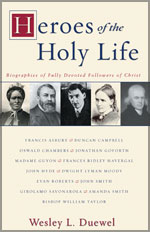
Recently, I found this book of Biographies written by Wesley L. Duewel. Wesley Duewel, is a former president of OMS International. A missionary to India for 25 years, Dr. Duewel is also the author of Ablaze for God, Mighty Prevailing Prayer, More God, More Power, and Revival Fire. This book feature some less written about figures, such as Francis Asbury, Duncan Campbell andJonathan Goforth. Of course, we also have our Oswald Chambers, Madame Guyon, and Dwight L. Moody!! I have always loved reading biographies and I think this book would be on my list of "books to read". ... ...

Title
Heroes of the Holy Life: Biographies of Fully Devoted Followers of Christ
(Date published: October 2002)

Written by:


Synopsis
The stories of 14 outstanding Christians, from the 14th through the 20th centuries, who by words and deeds set an example for Christians today to follow.

Description
Stories of fourteen outstanding Christians whose words and deeds set an example for believers today.This book recounts the life stories of outstanding Christians who inspire and challenge readers to live more godly lives. These fourteen men and women—some well known and others not—come from many parts of the world and from the 14th to the 20th centuries. These brief biographies highlight the events and special contributions each person has made to the church. Figures presented are Francis Asbury, Duncan Campbell, Oswald Chambers, Jonathan Goforth, Madame Guyon, Frances Ridly Havergal, John Hyde, Adoniram Judson, Dwight L. Moody, Evan Roberts, Girolamo Savonarola, Amanda Smith, John Smith, and Bishop William Taylor.

Wednesday, February 15, 2006

A Biblical Approach to Chinese Beliefs and Superstitions

On Saturday, January 14, 2006, in my article Superstitions?, I wrote a review of the book Don’t Sit On This Book: A Collection of Chinese Taboos And Superstitions (by Philip Cheong. Malaysia: The Academy of Feng Shui, 2005). I questioned some of the beliefs and Superstitions that the Chinese have during the Chinese New Year. Of course, Philip Cheong's book not only focuses on Chinese New Year's beliefs and Superstitions, other Chinese beliefs and Superstitions are discussed too. But, I only touched on these as it was nearing Chinese New Year then.

I also posted 2 questions:
"Do we Christians place more faith in passed-down beliefs than biblical truths?"
"Do we accept the bible with faith, with no questions asked?"

I have also posted a challenge to all Christians:
Maybe it is time to get back some of our misplaced faith!

However, in the tonnes of books that are published every year, it may be diffifult to find a book that can help us in gaining a biblical perspective on Chinese Traditions And Beliefs. Here is a book which has been useful to me.

A Biblical Approach To Chinese Traditions And Beliefs
Author: Daniel Tong
ISBN: 9814045926
In this carefully researched and thoughtfully written book, Daniel Tong ponders the dilemmas faced by many Chinese Christians. The book seeks to provide some guidelines on the cultural practices that believers may — or may not — be a part of, and offers sound biblical reasons for the decisions. It discusses the major festivals celebrated, the practice of ancestral worship and traditional Chinese medical care, and gives a brief description of the main tenets of the religious philosophies that undergird these traditions. The goal, asserts the author, is simply to help Christians live their faith to the fullest, while maintaining the fact that they come from an ethnic group with a long and rich heritage. (Usual price: $14.00; 208 pages)

For Evangelism, the above book may be a little bulky (though it's only 208 pages) and the reader may not finish the whole book. For a better "focus", the following 3 booklets may be useful. They are all extracted from A Biblical Approach To Chinese Traditions and Beliefs. At $2 dollar each, I think they are also affordably priced as a gift to non-Christians or new Christians.


Chinese Marriage Traditions: What's Right For The Christian?
Author: Daniel Tong
ISBN: 9814138509
Price : SGD 2.00
Extracted from the acclaimed A Biblical Approach To Chinese Traditions and Beliefs, this booklet gives Christians guidelines on the observance of Chinese marriage traditions. It helps believers to understand, among other things, the tea ceremony, the dowry and the timing of a wedding.


Traditional Chinese Medicine: What's Acceptable For The Christian?
Author: Daniel Tong
ISBN: 9814138525
Price : SGD 2.00
Extracted from the acclaimed A Biblical Approach To Chinese Traditions and Beliefs, this booklet gives Christians insights into traditional Chinese medicine. It helps believers to understand, among other things, the Daoist root in Chinese medicine, herbal remedies and acupuncture.

Chinese Funeral Practices: What's Right For The Christian?
Author: Daniel Tong
ISBN: 9814138525
Price : SGD 2.00
Extracted from the acclaimed A Biblical Approach To Chinese Traditions and Beliefs, this booklet gives Christians guidelines on the observance of Chinese funeral practices. It helps believers to understand, among other things, the funeral wake, prayer for the dead and the family altar.

Author's Info:
Daniel Tong is a graduate of TTC,Singapore. He has been a priest of the Anglican Diocese of Singapore for over 10 years, and is currently the Vicar of Chapel of Christ the Redeemer.

Divine, Human Love (3):Valentine?

For God so loVed the world
...... that he gAve
..... ..... his onLy
...... ..... ..... bEgotten
..... ..... .... SoN,
.... .... ..... .....That whoever
..... ..believes In him
..... ...... shall Not perish
...... but have Eternal life.

(John 3:16, NASB)

Saturday, February 11, 2006

Which Word?(3)

1) Understanding of Dao (the Word) (continued ...)

The Dao is beneath abstraction. As the totality of all things, Lao Zi describes the dao as indescribably great (Dao De Jing, Chapter 25):

I don't know his name,
as it's designation I call it Dào;
forced to provide it a name, I call it "great".


When we can comprehend the dao in all things, we come to know the de. (德,是“道”的物化,是“道”显现于物的功能。) De is how the dao operates in the world. De is the characteristic of the dao from the ethical point of view, but it is different from the de of Confucianism. In Daoism, de refers to the particular thing that is the source of its own potentiality, a thing that operates within the context of dao. In Confucianism, de is somewhat equivalent to what we call moral, which means “behaving in ways considered by most people to be correct and honest”. It is often translated as ‘virtue’, but it not virtue in the sense of Western morality, since the emphasis of the latter is often mainly on the individual.

As said earlier, dao can be taken as a metaphysical concept, but this was not Lao Zi's main concern. He sees the dao as a moral concept. With de("virtue", 德),the dao represents the ordering principle behind nature, society and the individual. It is the nameless unchanging essence and source of heaven and nature. Though the Dào of John’s gospel is unchanging, it is not a nameless essence. The Dào of the bible also has many names and it is not an essence. In the Old Testament, God is also called ELOHIM, EL SHADDAI, ADONAI, JEHOVAH, JEHOVAH-JIREH, JEHOVAH-ROPHE, JEHOVAH-NISSI, JEHOVAH-M'KADDESH, JEHOVAH-SHALOM, JEHOVAH-ROHI, JEHOVAH-SHAMMAH, EL ROI and so on. In the NT, God is also called THEOS, HUPSISTOS, and yes… our most familiar WORD (logos; John 1:1ff) and JESUS. Why does God have so many names? In Scripture, the Names of God has their significance, the names of God are like miniature portraits and promises. God's Names reveal God's identity, constitution, nature, character and essence. Though both Lao Zi and Zuang Zi are right in recognizing Dào as the beginning of all things, they have failed to see Dào as a divine being. For eg, some scientists claim that the Big Bang produced the universe, but the the Big Bang is not a being, but a happening (that’s what I think! It may be wrong though!). In a way, Lao Zi and Zuang Zi’s thoughts reflect the agnostic nature of the philosophical thought of China, or should I say their writings influenced of the philosophical thought of China.

2) Dao's characteristics

How does the bible describes Dao? In John 1:1(NIV), “In the beginning was the Word, and the Word was with God.” This verse shows that there is the Word and God.The Word and God are different as he was “with God”. The Word and God are the same as he “was God”, and “was with God in the beginning” (v.2). As Jesus in his High Priestly Prayer said, “Now, Father, glorify Me together with Yourself, with the glory which I had with You before the world was. (John 17:5) Jesus as the Word Incarnate enjoys an eternal relationship with the God the Father. We know that “love is from God; and everyone who loves is born of God and knows God. The one who does not love does not know God, for God is love.” (1 John 4:7-8). (See my previous reflection on Human & divine love!) For “God is love”, there must be someone who loves and someone to receive the love. The eternal relationship that God the Father and Jesus enjoy is this relationship of love. God exists as three-in-one and one-in-three in the ineffable exchange of love among the three persons of the Trinity.

In the first chapter of Dao De Jing, Lao Zi wrote:

The Way that can be experienced is not true;
The world that can be constructed is not true.
The Way manifests all that happens and may happen;
The world represents all that exists and may exist.

These are the first words of Dao De Jing. The Dao De Jing does not specifically define what the Tao is. Laozi himself reportedly said, "My words are very easy to understand [...] yet no one under heaven understands them." (chapter 70) However, we can point to some of the Tao's characteristics. Here, Lao Zi say that Dao (or “The Way”) is something extraordinary. It cannot be constructed.

In the fourth chapter of Dao De Jing, Lao Zi wrote:
The Way is a limitless vessel;
Used by the self, it is not filled by the world;It cannot be cut, knotted, dimmed or stilled;
Its depths are hidden, ubiquitous and eternal;
I don't know where it comes from;
It comes before nature.

The Original Chinese Version is: 

道冲而用之,或不盈。
渊兮,似万物之宗。湛兮,似或存。  
吾不知谁之子,象帝之先。

The last sentence of this chapter “吾不知谁之子,象帝之先” is uniquely written. However, the translation “I don't know where it comes from; It comes before nature.”isn’t very clear. I think another English translation which I found says it better: Was it too the child of something else? We cannot tell.But as a substanceless image it existed before the Ancestor.

Lao Zi says that the Way is a child, but he wasn’t able to say who it is? The “Ancestor” described by Lao Zi maybe the “Yellow Ancestor” (皇帝). Lao Zi describes it as existing before the first king of China. So, the question is: Is this “The Way” the God of the Bible? Maybe the bible can shed some light on this. About two to three hundred years before Lao Zi, the prophet Isaiah has already prophesized:

For to us a child is born,
to us a son is given, and the government will be on his shoulders.
And he will be called
Wonderful Counselor, Mighty God,
Everlasting Father, Prince of Peace. (Isaiah 9:6)

Isaiah said Jesus is the child that will be born, and he is the Prince of Peace. Isn’t this rather similar to Lao Zi’s portrayal of “The Way” as a child? Lao Zi’s description of “The Way” as eternal also matches Isaiah description of Jesus as “Everlasting”. However, Lao Zi’s understanding of “The Way” as “substanceless image” is against the biblical teaching. This is close to the Docetism’s view (a heresy) that Jesus only appear to be man. But the biblical teaching is that Jesus has full humanity. If it is a substanceless image, how could Jesus have died and have a bodily resurrection (Matthew 28:6)? Jesus needs to have full humanity so as to be the mediator btw God and Man (cf. 1 Tim 2:5).

Lao Zi’s view that “The Way” is ubiquitous is also problematic. “Ubiquitous” means “seeming to be in all places”, but we know that God is omnipresent; He cannot be limited by space as He created space. For Jesus, this view that He is ubiquitous is also problematic. With full humanity, Jesus is “limited” by space. So, to describe Him as being ubiquitous would be inappropriate. Wayne Grudem commented, “The divine doctrine of omnipresence is not directly affirmed to be true of Jesus during his earthly ministry” (Bible Doctrine, p. 239).

In Lao Zi’s writing, I think God has somehow miraculously revealed Himself. Thus, Christianity may not be an “ang-moh’s”(Westerner's) religion after all. The Chinese had the concept, or rather the knowledge, of “The Way” in their ancient writing (about 600 BCE).

The “Word (道)” described by John is Jesus. The word “知道” (understand) is an interesting word. We always say “知道” , “知道” , but I think it is not until we know Christ as our Saviour that we finally “知道”, that we finally understand, for Jesus is the only “道” can bring us into eternity with God.

Tuesday, February 07, 2006

Which Word? (2)

There are both differences and similarities btw the dao of the bible (as described by John in the opening of his gospel) and the dao of Lao Zi.

1) Understanding of Dao (the Word)

Lao Zi sees dao as eternal and present everywhere, but it is not perceivable by the senses or the mind. Difficult to define as it is, Dao is first and foremost be understood as an ontological rather than a temporal cause. It is a principle and the ultimate basis of change, though itself changeless. Dao extends beyond the human mind and beyond the human word. Dao can be comprehended through its effects or by observing the events in nature and human actions.

The general revelation provided by God is somewhat similar to the Taoist's understanding that Dao can be comprehended through its effects or by observing the events in nature and human actions. As David says, "The heavens are telling of the glory of God; And their expanse is declaring the work of His hands. " (Ps. 19:1, NASB) Or as the New International Reader's Version puts it more simply,"The skies show that his hands created them." (Ps. 19:1b) Whenever we look at the sky, we see the evidence of the infinite power, wisdom and glory of God. Romans 1:19-20 reiterates this, "For what can be known about God is plain to them, because God has shown it to them. For his invisible attributes, namely, his eternal power and divine nature have been clearly perceived, ever since the creation of the world, in the things that have been made. So they are without excuse." All men are able to recognise this evidence, but "although they knew God, they did not honor him as God or give thanks to him, but they became futile in their thinking, and their foolish hearts were darkened"(Romans 1:21).

Lao Zi said that we can use words to describe Dao, but this is at best only knowledge by description and not knowledge by acquaintance. I sense another similarity here. A Christian can have a lot of bible knowledge, but he may not know God personally. The thief who was hanged next to Jesus when he was crucified was not an expert of bible knowledge, but he recognized who Jesus was. This was something which the learned Pharisee was not able to see. Not that bible knowledge is useless, but bible knowledge should lead us to love God, to want to know Him. Bible knowledge, by itself, is useless as it cannot save us. But, It can point us to (help us to learn more about) the one who can save us, so that we can know God personally. This may be why it is written in Matthew 7:7-8, "Ask and it will be given to you; seek and you will find; knock and the door will be opened to you. For everyone who asks receives; he who seeks finds; and to him who knocks, the door will be opened.”

Sunday, February 05, 2006

Which Word?


John 1:1-4 reads:

1. In the beginning was the Word, and the Word was with God, and the Word was God.
2. He was with God in the beginning.
3. Through him all things were made; without him nothing was made that has been made.

4. In him was life, and that life was the light of men.

In the first verse of Gospel of John,the "Word" was mentioned . The next three verse proceeds to explain what this "Word".
The "Word" was not perculiar to the Christian faith. In Chinese philosophy, there is also the "Word". The Chinese call the "Word" Dao. This concept of Dao was formulated by Laozi in the Dao De Jing. The Dao literally means the way. In Chinese, both the "Word" (of the Bible, as in all Chinese translation) and Dao is represented by the character "道". Interestingly, when the Jesuit scholars first translated the Dao De Jing, they imbued the Dao with religious significance. However, the Chinese concept of Dao of Heaven (or Tian Dao), unlike the Christian understanding of Dao, there is no connortation of a personal God. Regardless of whether it is the Dao of man, the Dao of nature or the Dao of Heaven, Dao is not about God. Rather, it is a road, the path. Dao has been interpreted differently by many interpretors. Some say it is the cosmic substance before all determination and a unique substance in which yin (阴) and yang (阳) are only modes. However, taken as a metaphysical concet, its meaning remain illusive.

In the Dao De Jing, it is written: All things are produced and nourished by its outflowing operation (de) . They receive their forms according to the nature of each, and are completed according to the circumstances of their condition (51). In other words, Lao Zi sees Dao as eternal and present everywhere. Hmm..., isn't there some similarities here btw what he perceives and what is said in John 1:1? Lao Zi said the dao is the source and origin of all things. In a way, the dao is analogus to logos (of the bible) as the principle which creates order. The difference is that the dao as perceived by Lao Zi is not God.

In Hebrews 1:3 (NIV), we read, "The Son is the radiance of God's glory and the exact representation of his being, sustaining all things by his powerful word. After he had provided purification for sins, he sat down at the right hand of the Majesty in heaven." Is "nourished" the same as "sustaining all things"? Hmm... I think this would be one of the things I'll be thinking about for the next few days! boring? .... ??

Excellent Theological Resource!


Found this amazing resource "Covenant Worldwide" at the website of Covenant Theological Seminary. This resource is a "free educational resource for faculty, students, and self-learners around the world." As the website describes, "It flows from Covenant Theological Seminary's grace-centered Gospel mission and exists to make high-quality, graduate-level theological education available to those who do not have the ability to attend seminary." The courses posted on this Web site comprise Covenant Seminary's Master of Arts in Theological Studies degree. Lectures are in MP3 format, and study guides are available as PDFs. It is indeed most kind of Covenant Theological Seminary to make such complete & high-quality theological resource available to those who want to know more about God's Word. I really thank God for their efforts. May God bless them richly in their ministry. Really hope to see other seminaries emulate CTS's effort. Amen.

Friday, February 03, 2006

Divine Love & Human Love

Channel News Asia's Get Rea! have always been able to report on issues which reflect society's values in a very real way (that's what i think!?) & this interest me. I think the name of the program "Get Rea! " is very appropriate. The host Diana Ser is able to report with feelings. In a recent episode where she reported on the jobs of so-called "invinsible people"(can't remember very clearly! but it refers to those whose work as a cleaner.), she even tried to be a cleaner to experience the cleaners' feeelings. The cleaners interviewed say most (hope I didn't hear wrongly!) people shun them. The job of a cleaner is being looked down upon.

The Channel News Asia is conducting an online poll and it wants the public's view on what irks us most. Singapore is a first world country. But do we have the social graces to go with it? Take part in the
online poll. (The findings of the poll will be released on Get Rea! at 8.30pm on 8 Feb 2006 (Wed.) ) There are 5 questions. Of the five questions, what Q5 describes annoyed m most.
Q5: People who are rude to service staff, maids and cleaners etc.
Do you find this annoying?

Being rude to people is a terrible thing. But, what I find even more annoying is mistreating others who does not have the ability to go against us. To mistreat means to treat badly, cruelly or unfairly. Recently, there is thee case of this employer who allegedly (oops, I think she has pleaded guilty! The court has reserved judgment and the case will be heard again on February 7.) caused the death of her domestic worker. The employer had instructed her 22-year-old maid to hang laundry on a ledge barely one metre wide outside the study of her Windermere condominium in Choa Chu Kang on 20 December 2003. Being rich doesn't mean we could tell others to do whatever we want. If we were the maid, how would we feel? This is a simple truth & i don't think one needs a Ph.D. to understand that "己所不欲,勿施于人
" (What you do not wish upon yourself, extend not to others. --- Confucius's Analect, Chapter 15.) I have also heard "stories" where maids are only to have their meals after their employers (some are Christians, or they profess to be) finish theirs. ... The maids eat the leftovers.

Continuating my reflection on Divine love & Human love, I think service staff, maids and cleaners etc. are all people making an honest living. Their jobs should not be looked down by others. Indeed, it always saddens me to see pple being rude to service staff, maids and cleaners etc. When people say Christians are hypocrites, I don't think they have always been unfair. However, whenever I see the people being rude to service staff, maids and cleaners etc. are Christians, I feel those who say Christians are hypocrites may be right in some cases. In these cases, I think we indeed need to repent. How can we not love others when God loves us?

We fail to remember that all that we are, all that we do, and all that we have has been given to us as steward of the gifts of the LORD God our Maker.

“You shall love your neighbour as yourself” (19:18; cf. Mk 12:29-31). Very often, I think we like to ask questions, but when we are given answers we dislike, we shut our ears to them. We start interpreting "neighbour" according to our defintion! We forgot that since God has first loved us (cf. 1 Jn 4:10), love is now no longer a mere “command”; it is the response to the gift of love with which God draws near to us. Those who say theology is useless should note that the biblical concept of Total depravity & sola gratia reminds us that we are not worth God's love. (Biblical Anthropology too!!)

I think it was Robert Schuller who sees "self-love" as spiritually freeing. He denies the biblical teaching of salvation, sin, the sinful nature of man, and original sin. While many many of us Singapore Christians may not know Schuller, but I think many Christians subscribe to his view. We think that "self-love" is more important. Nevermind what the bible says, they say. Very often, many churches tell their members God loves them, but they sledom mention sin, the sinful nature of man, and original sin. This is call preaching to please the audience.

“If anyone says, ‘I love God,' and hates his brother, he is a liar; for he who does not love his brother whom he has seen, cannot love God whom he has not seen” (1 Jn 4:20). In this text, we see that the unbreakable bond between love of God and love of neighbour emphasized.

I think Pope Benedict XVI is right when he says (forgive me if I sound presumptuous!), "Saint John's words should rather be interpreted to mean that love of neighbour is a path that leads to the encounter with God, and that closing our eyes to our neighbour also blinds us to God."

God has become visible in that he“has sent his only Son into the world, so that we might live through him” (1 Jn 4:9). God has made himself visible: in Jesus we are able to see the Father (cf. Jn 14:9). The incarnation of God shows that he has loved us first and he continues to do so; we too, then, can respond with love. To quote again from the Deus Caritas Est: God does not demand of us a feeling which we ourselves are incapable of producing. He loves us, he makes us see and experience his love, and since he has “loved us first”, love can also blossom as a response within us.

Deus Caritas Est: Love of neighbour is shown to be possible in the way proclaimed by the Bible, by Jesus. It consists in the very fact that, in God and with God, I love even the person whom I do not like or even know. This can only take place on the basis of an intimate encounter with God.

I think this is a simple, yet seldom praticed biblical truth. For eg., we often say we have an intimate encounter with God, but when we hear someone criticizing our beliefs, we turn our "artillery" towards that person & start firing, defending, ... ... & yes, without love! How do we know? By the way they sound! By the words they use!

We need to learn to look on the person whom I do not like (or even know) not simply with my eyes and my feelings, but from the perspective of Jesus Christ.

John Calvin once said, "We must not be hindered by the malice of men, but rather contemplate the image of God in them, which by its excellence and dignity moves and enables us to love them."

I think the Deus Caritas Est echoes John Calvin's (or should I say the biblical view): If I have no contact whatsoever with God in my life, then I cannot see in the other anything more than the other, and I am incapable of seeing in him the image of God.

Deus Caritas Est: But if in my life I fail completely to heed others, solely out of a desire to be“devout” and to perform my “religious duties”, then my relationship with God will also grow arid. It becomes merely“proper”, but loveless. Only my readiness to encounter my neighbour and to show him love makes me sensitive to God as well.

I think this is most true of many of us Christians (regardless of RCC or not). We try to look loving, look “proper”, but others can sense that we lack what we are trying to "look". We may performreligious duties such as being the usher, being paert of the worship team, being a cell group leader, or evern speak in tongues, etc. But, these can never be a substitute for love. As 1 Corinthians 13 (NIV) reminds us:

1. If I speak in the tongues of men and of angels, but have not love, I am only a resounding gong or a clanging cymbal.
2. If I have the gift of prophecy and can fathom all mysteries and all knowledge, and if I have a faith that can move mountains, but have not love, I am nothing.
3. If I give all I possess to the poor and surrender my body to the flames, but have not love, I gain nothing.
4. Love is patient, love is kind. It does not envy, it does not boast, it is not proud.
5. It is not rude, it is not self-seeking, it is not easily angered, it keeps no record of wrongs.
... ...
13. And now these three remain: faith, hope and love. But the greatest of these is love.


Can the bible be more clear than this concerning the importance of love?

In Genesis, God said, "Let us make man in our image, in our likeness." (Genesis 1:26-27, NIV) It simply means that "A human being is the image of God." To be created in the image of God means that we have not only the ability, but indeed privilege, of relating to, serving, and loving our heavenly Father. However, have we served God? Have we loved God?

From the same mouth come blessing and cursing. My brothers, these things ought not to be so. (James 3:10, ESV)
Out of the same mouth come praise and cursing. My brothers, this should not be. (James 3:10,NIV)

Or more clearly, in James 3:10, it says, "Out of the same mouth comes praise for God and curses for the image of God." And then he says, "My brothers, these things ought not to be so." That's why the apostle John in the New Testament says, "Don’t even talk to me about loving God if you don't love your neighbor." (1 Jn 4:20) From theses texts, we see that the way we treat an image of God is the way we're treating God.

Insteading of being unloving to the image of God, we should be multiplying the images of God. We should be spreading the Gospel. When we bring people into the faith we're actually multiplying redeemed images of God. Evangelism is not about teaching and raising second generation Christians. When we are loving & nice to somebody in Jesus' name, we evangelise, we witness. When we bring somebody to church & we say, "Have you ever considered the claims of Jesus on your life?", we need also to ask whether our lives reflect the the power of the cross, whether our lives reflect the awesome love of God? Many who chose not to believe say, "So what if God loves us, but we don't see Christians being loving. If God can't change their attitude, I don't see how He can save me!"

What's our response? May God help us to love Him & others.

Thursday, February 02, 2006

A Introductory Guide to Christian Beliefs


Dr Wayne Grudem has always been one of my favourite authors. His Systematic Theology, Bible Doctrine (abridged ed. of his Systematic Theology) for example, has been a useful resource for me. Very recently (2005 Winter), he has produced another new bk titled Christian Beliefs:Twenty Basics Every Christian Should Know. I suppose this is an abridged ed. of his Bible Doctrine!! For me, abridged doesn't always mean bad quality or too brief to be useful. As the Synopsis describes, it is a basic guide to twenty Christian beliefs that is solid, yet readable, and not intimidating for new believers and Christians in general. It includes chapter review questions.

Description of Christian Beliefs:Twenty Basics Every Christian Should Know

Albert Mohler Jr. (President, The Southern Baptist Theological Seminary, Louisville, Kentucky) descrbe this bk as:

Christian Essentials Made Plain and SimpleGod doesn’t call every Christian to go off to seminary, but there are certain matters of doctrine—that is, the church’s teaching—that every Christian simply must know. Theology is important because what we believe affects how we live. If you’re a relatively new believer in Jesus, or if you’re a more mature Christian looking for a quick brush-up on basics of the faith, Christian Beliefs is for you.This readable guide to twenty basic Christian beliefs is a condensation of Wayne Grudem’s award-winning book on systematic theology, prized by pastors and teachers everywhere. He and his son, Elliot, have boiled down the essentials of Christian theology for the average layperson and made them both clear and applicable to life. You will learn about the Bible, the characteristics of God, what it means that we are created in the image of God, what God has done for us in Christ, the purpose of the church, and much more. Each chapter includes questions for personal review or group discussion.These truly are twenty basic beliefs that every Christian should know. Wayne Grudem is a master teacher with the ability to explain profound truths in simple language. He is a man of deep conviction and theological passion—and those who read this book will be both educated and encouraged in the faith.

J. I. Packer (Regent College, Vancouver, British Columbia) too gave his endorsement:

Based on Systematic Theology, this summary will certainly help beginners with
Christ to get the hang of their faith.

Table of Contents

1. What Is the Bible?.....

2. What Is God Like?.....

3. What Is the Trinity?.....

4. What Is Creation?.....

5. What Is Prayer?.....

6. What Are Angels, Satan, and Demons?.....

7. What Is Man?.....

8. What Is Sin?.....

9. Who Is Christ?.....

10. What Is the Atonement?.....

11. What Is the Resurrection?.....

12. What Is Election?.....

13. What Does It Mean to Become a Christian?.....

14. What Are Justification and Adoption?.....

15. What Are Sanctification and Perseverance?.....

16. What Is Death?.....

17. What Is the Church?.....

18. What Will Happen When Christ Returns?.....

19. What Is the Final Judgment?.....

20. What Is Heaven?.....

Appendix 1: Historic Confessions of Faith.....

Appendix 2:Books for Further Reading in Systematic Theology.....

Author's info: Dr Wayne Grudem was previously professor of biblical and systematic theology at Trinity Evangelical Divinity School in Deerfield, Illinois. He holds degrees from Harvard (BA), Westminster Seminary (MDiv), and the Cambridge (PhD). He is author of a number of books, including the Silver Medallion Award-winning Systematic Theology. He is also the co-editor of Recovering Biblical Manhood and Womanhood.

Wednesday, February 01, 2006

Divine, Human Love (2): Being a witness

Continuing with my reflection on the topic of Divine, Human Love … …
I think I’ll start with Human Love & how it is related to being a witness to our faith.

Being a witness?
But you will receive power when the Holy Spirit comes on you; and you will be my witnesses in Jerusalem, and in all Judea and Samaria, and to the ends of the earth." (Acts 1:8, NIV)

What does the word “witnesses” mean?
The word “witnesses” is μαρτυρε in greek & it occurs 24 times throughout Acts. Our English word "martyr" is a direct translation of the Greek word μαρτυρε. According to the Cambridge Learner’s Dict.., a martyr is a “person who suffers greatly or is killed because of their political or religious beliefs, and is often admired because of it”.

In contemporary church, has Christians failed in their witnesses?
Certainly, we are no martyr. However, what about the basics? (which seem to be the most difficult to live out too!)
How about our unloving acts?
Do we live the lives similar to that of non-Christians?
Why then do so many (that's what I think!) Christians, as well as non-Christians, accused the church of hypocrisy?
I was reading J. Bridges’ book The Discipline of Grace. I think he most rightly commented that most often our sin problems is in the area of refined sins. Yes, we may not murder, kill, rob, steal, commit adultery, ill-treat maids, … … We may not support physician assisted killing, homosexual acts, … We may not have commit these (grievous) acts, but unloving, unkind, proud, bias, judgmental, selfish, self-centered, gossip, impatience, rude, self-righteous, … … Are we not guilty? Here are more examples:

In the church … …
We do not smile when we see a new-comer.
We do not smile when we see someone we do not know.
We do not smile when we see someone we do not like.
We do not smile when we see someone not belonging to our “gang”.
We do not smile when we see someone who has make us angry before.
We do not smile when we see someone who our friends do not like.
We do not smile when we see someone who our pastors do not like!

Note:
“Smile” is only an example, it is replaceable with: talk to, shake hands with, mix around with, have fellowship/ bible study with, be friends with, … … (the list can be endless.)
Very sadly, the “We” can be any Christians. Lay, clergy, deacons, elder, pastors, Sunday school teachers, cell group leaders, ushers, … … are all guilty at one time or the other!!

In between … …
We spend too much time gossiping than spreading the great commission.
We spend too much time doing our own things than doing God’s.
We spend more time thinking about my money which is in bank than our father who art in heaven.
We spend more time grumbling than praying.
We make more people unhappy than disciples?
We only spread the gospel to the people we like!
We only include the people we like in our cell group/ bible study!
We only go to the church whose pastors we like! (We do not care much about its teachings.)
We only read the bible version we like! (We do not care much about its reliability!)
We only go to the church whose worship style we like! (We do not if it is biblical.)
We only read Christian literature whose authors we like!
We only give to God the amount we like! (We do not care much about the church’s need.)

In private … …
We pray that my salary come (hopefully faster) rather than thy kingdom come.
We pray my will be done rather than thy will be done.
We pray give us this day more money rather than give us this day our daily bread.
We pray that others forget our debts rather than forgive us our debts.

Some thoughts … …
Many a times, people (non-Christians) do not see the Christ-likeness in us Christians who are the body of Christ.
"Do not be conformed to this world (Rom 12:2)." Is what we lack & maybe what we have missed. “To be conformed to the image of his Son” is what we need (Rom 8:29).We need a metamorphosis!!
“The Gospel becomes credible when it is visible as well as audible.” –-Rev Dr John Stott.
Jesus said, “you will be my witnesses”, what’s our response?

All the above acts of lack of Christ-likeness are mainly due to the lack of love for God & fellow Christians.

Does our Christian Testimony show:
the change that happened in our life when we invited Jesus Christ into our life?
the power of God that changed us and make us look at life in a whole different way?
the power of the cross?
the awesome love of God?
that God, Jesus Christ and the Holy Spirit (known as the trinity) does exist? (From the love btw the persons of the trinity, we learn to love.)

Friday, January 27, 2006

Papal Encyclical Explores Divine, Human Love

On 25 Jan 2006 , Pope Benedict XVI issued his first Papal encyclical Deus Caritas Est ("God is love"). Below are some points which I think both evangelicals & Catholics agree upon. These are the points which I think the church most lack!

Here are some insightful points from the encyclical:

"God is love, and he who abides in love abides in God, and God abides in him” (1 Jn 4:16). These words from the First Letter of John express with remarkable clarity the heart of the Christian faith: the Christian image of God and the resulting image of mankind and its destiny.

Hear, O Israel: the Lord our God is one Lord, and you shall love the Lord your God with all your heart, and with all your soul and with all your might” (6:4-5). Jesus united into a single precept this commandment of love for God and the commandment of love for neighbour found in the Book of Leviticus: “You shall love your neighbour as yourself” (19:18; cf. Mk 12:29-31). Since God has first loved us (cf. 1 Jn 4:10), love is now no longer a mere “command”; it is the response to the gift of love with which God draws near to us.

Love of God and love of neighbour
16. ... ... can we love God without seeing him? And can love be commanded? Against the double commandment of love these questions raise a double objection. No one has ever seen God, so how could we love him? Moreover, love cannot be commanded; it is ultimately a feeling that is either there or not, nor can it be produced by the will. Scripture seems to reinforce the first objection when it states: “If anyone says, ‘I love God,' and hates his brother, he is a liar; for he who does not love his brother whom he has seen, cannot love God whom he has not seen” (1 Jn 4:20). But this text hardly excludes the love of God as something impossible. On the contrary, the whole context of the passage quoted from the First Letter of John shows that such love is explicitly demanded. The unbreakable bond between love of God and love of neighbour is emphasized. One is so closely connected to the other that to say that we love God becomes a lie if we are closed to our neighbour or hate him altogether. Saint John's words should rather be interpreted to mean that love of neighbour is a path that leads to the encounter with God, and that closing our eyes to our neighbour also blinds us to God.

17. True, no one has ever seen God as he is. And yet God is not totally invisible to us; he does not remain completely inaccessible. God loved us first, says the Letter of John quoted above (cf. 4:10), and this love of God has appeared in our midst. He has become visible in as much as he “has sent his only Son into the world, so that we might live through him” (1 Jn 4:9). God has made himself visible: in Jesus we are able to see the Father (cf. Jn 14:9). Indeed, God is visible in a number of ways. In the love-story recounted by the Bible, he comes towards us, he seeks to win our hearts, all the way to the Last Supper, to the piercing of his heart on the Cross, to his appearances after the Resurrection and to the great deeds by which, through the activity of the Apostles, he guided the nascent Church along its path. Nor has the Lord been absent from subsequent Church history: he encounters us ever anew, in the men and women who reflect his presence, in his word, in the sacraments, and especially in the Eucharist. In the Church's Liturgy, in her prayer, in the living community of believers, we experience the love of God, we perceive his presence and we thus learn to recognize that presence in our daily lives. He has loved us first and he continues to do so; we too, then, can respond with love. God does not demand of us a feeling which we ourselves are incapable of producing. He loves us, he makes us see and experience his love, and since he has “loved us first”, love can also blossom as a response within us.

18. Love of neighbour is thus shown to be possible in the way proclaimed by the Bible, by Jesus. It consists in the very fact that, in God and with God, I love even the person whom I do not like or even know. This can only take place on the basis of an intimate encounter with God, an encounter which has become a communion of will, even affecting my feelings. Then I learn to look on this other person not simply with my eyes and my feelings, but from the perspective of Jesus Christ. His friend is my friend. Going beyond exterior appearances, I perceive in others an interior desire for a sign of love, of concern. This I can offer them not only through the organizations intended for such purposes, accepting it perhaps as a political necessity. Seeing with the eyes of Christ, I can give to others much more than their outward necessities; I can give them the look of love which they crave. Here we see the necessary interplay between love of God and love of neighbour which the First Letter of John speaks of with such insistence. If I have no contact whatsoever with God in my life, then I cannot see in the other anything more than the other, and I am incapable of seeing in him the image of God. But if in my life I fail completely to heed others, solely out of a desire to be “devout” and to perform my “religious duties”, then my relationship with God will also grow arid. It becomes merely “proper”, but loveless. Only my readiness to encounter my neighbour and to show him love makes me sensitive to God as well. Only if I serve my neighbour can my eyes be opened to what God does for me and how much he loves me. The saints—consider the example of Blessed Teresa of Calcutta—constantly renewed their capacity for love of neighbour from their encounter with the Eucharistic Lord, and conversely this encounter acquired its real- ism and depth in their service to others. Love of God and love of neighbour are thus inseparable, they form a single commandment. But both live from the love of God who has loved us first. No longer is it a question, then, of a “commandment” imposed from without and calling for the impossible, but rather of a freely-bestowed experience of love from within, a love which by its very nature must then be shared with others. Love grows through love. Love is “divine” because it comes from God and unites us to God; through this unifying process it makes us a “we” which transcends our divisions and makes us one, until in the end God is “all in all” (1 Cor 15:28).
(for full article)

Do we Christians agree?
More importantly, do we love God? Do we love others?

Monday, January 23, 2006

Darwinism vs. Evolution?

"Looking at the doctrine of Darwinism, which undergirded my atheism for so many years, I realized I would have to believe that nothing produces everything, non-life produces life, randomness produces fine-tuning, chaos produces information, unconsciousness produces consciousness, and non-reason produces reason." -- Lee Strobel, The Case for a Creator

Sunday, January 22, 2006

From our belief in the sanctity of life to trusting God

In an article Supreme Court Upholds Oregon's Suicide Law of this week of the Christianity Today, it was reported that:
The U.S. attorney general overstepped his bounds when he tried to stop the state of Oregon from implementing its 1997 physician-assisted suicide bill, the Supreme Court ruled Tuesday in a 6-3 decision. In 2001, Attorney General John Ashcroft issued a directive "that assisting suicide is not a 'legitimate medical purpose'... and that prescribing, dispensing, or administering federally controlled substances to assist suicide violates the CSA [Controlled Substances Act]." Using such drugs to assist with suicide could lead to "suspension or revocation" of a doctor's medical license, Ashcroft wrote. According to Pew Forum on Religion & Public Life, 46% of Americans support the right to assisted suicide while 45% oppose the
practice....

When Joni Eareckson Tada was interviewed as to what led her to write The Life and Death Dilemma, she replied that:

Twenty-eight years in a wheelchair has introduced me to the world of advocacy, and with it, thousands of people who were either sinking into or surfacing out of suicidal despair. While straining to cope with their own pain, people are learning that they're part of a confusing debate in society over medical issues ranging from physician-assisted suicide to rationed health care. Having observed the pain experienced by people and having participated in the public debate on issues such as euthanasia and health care, I'm convinced that the crisis has become the norm for our society. I wrote this to engage readers' hearts in what God has to say about their own crises.
According to Pew Forum on Religion & Public Life, there was a Strong Public Support for Right to Die (Released: January 5, 2006). In the Summary of Findings,

  • An overwhelming majority of the public supports laws that give patients the right to decide whether they want to be kept alive through medical treatment. And fully 70% say there are circumstances when patients should be allowed to die, while just 22% believe that doctors and nurses should always do everything possible to save a patient.
  • Though Americans are broadly supportive of allowing patients and their families to decide whether medical treatment should be removed, the public is divided over laws that let doctors prescribe lethal doses of drugs to assist terminally ill patients end their lives.

  • By two-to-one (61%-30%) white evangelical Protestants oppose physician-assisted suicide laws; by nearly identical margins, white mainline Protestants and seculars approve of such laws. Catholics, on balance, oppose such laws (by 50%-40%).

  • Views on assisted suicide are also affected by the amount of thought given to end-of-life issues; 57% of those who have given a great deal of thought to these issues approve of legal assisted suicide, a view shared by only 35% of those who have given little or no thought to these matters.
Very interstingly,the survey also found that:

While most people support the general idea of stopping medical treatment in some circumstances, fewer would personally ask their doctor to cut off treatment if they faced a terminal or debilitating illness. If facing an incurable illness and suffering a great deal of physical pain, 53% would opt to stop medical treatment, while 34% would tell their doctor to do everything possible to save their life.

To this, I think an important that need to be asked is do we have a Moral Right to End One's Own Life? What does ending one's own life reflect of one's beliefs? What are the implications to Christians? As Christians, we trust God as our Savoiur, we can come to Him when we are in distress. When suffering Christians end their own life, what are they tellling non-Christians? Joni Eareckson Tada was for twenty-eight years in a wheelchair (due to quadriplegics). Especially to those who love sports & outdoor activities, being immobile can be as good as being dead. However, Tada faces her pain bravely with the help of God. Not only bravely, she lived wonderfully fruitful lives. She is the founder and president of Joni and Friends, an organization accelerating Christian outreach in the disability community that numbers 550 million people worldwide. As Christians, what is our view on the moral right to end our own life? The survey showed that:

on this question are also strongly related to the respondent's religious beliefs, as well as to party and ideology. Fewer than half of white evangelical Protestants (42%) believe that an individual suffering a great deal of pain with no hope of improvement has a moral right to end their life, compared with 73% of white mainline Protestants. Most Catholics (60%) support the moral right to suicide under these circumstances, as do an overwhelming majority of seculars (78%). Similarly wide disparities are seen in terms of church attendance, with frequent attenders less supportive of such a right.

I think the findings "frequent attenders less supportive of such a right" says much about the importance of attending Church.

When we do not attend Church, or attend Church when we are free, or when we feel like it, or see worshipping God only as a seasonal activity(Christmas & Easter), when who sees worshipping God as a waste of time,I think we fail to see His Greatness. We have also deprive ourselves of the chance of learning His Greatness, the great truth that God loves us, that He will sustain us through our sufferings. When we do not attend Church, it also shows that we failed to see the importance of worshipping Him. we failed to see His Greatness. If God can create the world of His Word (ex nihilo, meaning out of nothing), He definitely can give us strength to live through our most difficult moments. When we do not attend Church, we are in a way saying that God is not worthy our worship. It shows how small, how limited, how powerless we have reduced our God to.

Dr. Charles Stanley once said that God is greater than our problems and is surely able to resolve them all. So cast all your cares upon Him because he cares for you. This reminds me of a hymn, "If you will only let God guide you" (Words:Georg Neumark,1641):

If you will only let God guide you, And hope in Him through all your ways,Whatever comes, He’ll stand beside you,To bear you through the evil days;Who trusts in God's unchanging loveBuilds on the Rock that cannot move. ... ... God hears the call of those in need,The souls that trust in Him indeed.

In in the Word of God, we can find much comfort. For example, as the psalmist writes, "He will be our Guide even to the end.","Psalm 48:14". Psalms 46.1 God is our refuge and strength, an ever – present help in trouble. Psalms 18:30 As for God, His way is perfect: The word of the Lord is tried: He is a buckler to all those that trust in Him.

Isaiah 55:8-9 (ESV):

For my thoughts are not your thoughts, neither are your ways my ways, declares the LORD. For as the heavens are higher than the earth, so are my ways higher than your ways and my thoughts than your thoughts.

Fanny Crosby, who lost her sight at six week of age through improper medical treatment by an inept doc­tor. She wrote thousands of hymns (over 8,000 Christian hymns!!) despite the handicapped she struggled with during her life. Her hymns revealed the triumph God gave her over a life of blindness. In her hymn "All the Way my Saviour leads me", she reminded us that God has never promised to keep us from hard places or obstacles in life. He has assured us, however, that he will go with us, guide each step, and give the necessary grace.

All the way my Savior leads me-
What have I to ask beside?
Can I doubt His tender mercy,
Who through life has been my guide?
Heavenly peace, divinest comfort,
Here by faith in Him to dwell!
For I know, whate'er befall me,
Jesus doeth all things well;
For I know, whate'er befall me,
Jesus doeth all things well.

This beloved hymn came to Fanny as a result of a prayer. Struggling financially, she desperately needed some money. As her usual custom, Fanny began to pray. A few minutes later, a gentleman offered her five dollars, the exact amount she needed. Later recalling the incident, she said, “I have no way of accounting for this except to believe that God put it into the heart of this good man to bring the money.” The poem she wrote afterward became “All The Way My Savior Leads Me.” As both a songwriter and a woman of faith, Fanny Crosby serves as an example to all. (Source: Hymn Stories)

In the 214th General Assembly of PC (USA), on "Christian and Reformed View of Human Life in Relation to the Practices of Euthanasia, Assisted Death, Assisted Suicide, Abortion, and Infanticide", I found the following:

Christianity has historically supported life and God's sovereignty over all aspects of life. But recently, most of the debate regarding euthanasia, assisted-suicide, abortion, and infanticide has been almost entirely conducted in a framework of cultural standards, issues of individual rights, and the legal precedents of the secular realm.

Although the church's witness to the world cannot be made in a vacuum devoid of contextual issues, we must remember that Reformed theology and orthodox Christianity have always sought to affect society and the culture by using the biblical framework to influence behavior and attitudes.

However, in seeking relevance, the church has begun to lose its significance, and in pursuing identification with the culture, it has begun to lose its uniqueness with Christ. We are not simply members of the culture. Instead, we are called to be different from culture as a light on a hill or salt that has not lost its saltiness.

In the Reformed theological tradition, the extent of God's command has been expressed in both the Westminster Shorter and the Larger Catechism.

In the Shorter Catechism, we have the following statements:

Q. 68 What is required in the Sixth commandment?

A. The Sixth commandment requireth all lawful endeavors to preserve our own life and the life of others.

Q. 69 What is forbidden in the Sixth Commandment?

A. The Sixth commandment forbiddeth the taking away of our life, or the life of our neighbor unjustly, or whatsoever tendeth thereunto.

In the Larger Catechism, we find these obligations considerably expanded, for there we read as follows:

Q. 135 What are the duties required in the Sixth Commandment?

A. The duties required in the Sixth Commandment are: all careful studies and lawful endeavors, to preserve the life of ourselves and others, by resisting all thoughts and purposes, subduing all passions and avoiding all occasions, temptations and practices which tend to the unjust taking away the life of any, by just defense thereof against violence; patient bearing of the hand of God, quietness of mind, cheerfulness of spirit, a sober use of meat, drink, physic, sleep, labor and recreation; by charitable thoughts, love, compassion, meekness, gentleness, kindness; peaceable, mild, courteous speeches and behavior, forbearance, readiness to be reconciled, patient bearing and forgiving of injuries, and requiting good for evil, comforting and succoring the distressed, and protecting and defending the innocent.

Q.136 What are the sins forbidden in the Sixth Commandment?

A. The sins forbidden in the Sixth Commandment are: all taking away from the life of ourselves or of others, except in the case of public justice lawful war, or necessary defense; the neglecting or withdrawing the lawful or necessary means of preservation of life, sinful anger, hatred, envy, desire of revenge, all excessive passions; distracting cares; immoderate use of mean, drink, labor and recreation; provoking words oppression quarreling, striking, wounding and whatsoever else tends to the destruction of the life of any.

I think The Shorter and the Larger Catechism is clear on the issue of Euthanasia (physician-assisted suicide/ mercy killing). Euthanasia involves suicide and/or murder. It is,therefore, contrary to God's Law.

How about death sentence? Exodus 22:2 (NIV) writes: "If a thief is caught breaking in and is struck so that he dies, the defender is not guilty of bloodshed." The authority to take a human life is given to individual men under only one circumstance: a defensive emergency. Nehemiah 4:14(NASB):

When I saw their fear, I rose and spoke to the nobles, the officials and the rest of the people: "Do not be afraid of them; remember the Lord who is great and awesome, and fight for your brothers, your sons, your daughters, your wives and your houses."

The civil government is given the authority to take human life in fulfilling its responsibilities for administering justice and national defense. (see also Romans 13:3-5) As Euthanasia falls under neither the categories of defensive emergency or administering justice and national defense, it should not be practised. Dr. John M. Frame in his book The Doctrine of the Christian Life (forthcoming) commented:

Liberal secularists tend to oppose killing in war and capital punishment, but to
accept abortion and euthanasia. Biblical ethics, in my view, teaches the
reverse. We must grant, of course that not all war and capital punishment is
just. (p. 669)

In Euthanasia: Not Our Burden to Bear, the author gives this helpful oberservation:

Often when we are tempted to take on more responsibility or authority than God gives, we fall into pragmatism to justify our actions. Pragmatism is an ethic that justifies means by expected ends. In other words, methods are judged by the results. ... ... Anytime we suggest that doing things as God instructs will not work, we are falling into pragmatism.

Often advocates of euthanasia are operating with just such a pragmatic ethic. We see a situation and come to the conclusion that this life is not worthy of existence. It seems the greater good would be served by the death of this person. Sometimes, we might even be right. Sometimes death is a great relief to the suffering. But it is simply not our responsibility to determine when that is the case, or to make it happen. God does not give us that burden. He reserves it for Himself.

Dr. John M. Frame in his book in his The Doctrine of the Christian Life (forthcoming) also rightly pointed out:

God sets no standards in Scripture for a “quality of life” that gives a person a right to life and an obligation to live. In current discussion, quality of life is in the eye of the beholder. It should not be made a standard of who shall live and who shall die. All children of Adam, made in God's image, have a right to life and an obligation to live as long as God allows.

So God’s command, “you shall not murder” applies to people who are suffering. We have seen that we have some freedom as to what medical care should be given to suffering patients. But we do not have the freedom to kill them. (p. 688)

Helpful website: PC (USA) on End of Life Issues

For more blogs, views & comments on this issue: Right Faith
Saturday, January 21, 2006

Some thoughts on John Wesley's view of Scripture (2)

In the book Christianity According to the Wesleys (Baker, 1996), ...

I found some very interseting comments:

Distribution of Bibles without simultaneous proclamation of the Word is but a very inferior procedure (p. 17)

... ...

Friday, January 20, 2006

Hearing God In the Scripture?

Very often, we read the bible & ask this question, "Where is God? Why can't I hear/experience him?".

This question leads me to another question, "Why do we have negative experience?" Maybe it is to lead us to God! How can this be possible? Yes, it is possible. The bible says so!

“Many people in the bible were called during intensely negative experience. However, what the Bible people discover to their astonishments is that their so-called negative experience often turns out to be stunningly positive.” (R. K. Hudnut. Call Waiting: How to Hear God Speak. InterVarsity Press, 1999.) For example, Hannah heard God speaks in anguish. For Job, who has often been characterized as the perfect Christian, his call came in times of arrogance.

Something I read recently …

Something I read recently …
“'pneuma' is neuter but was written in masculine in NT ”

Some thoughts …
According to Pocket Dictionary for the Study of New Testament Greek (Matthew D Ross, IVP), neuter (adj.) designates one of the three genders in Greek (the others being masculine and feminine).

However, on the point “but was written in masculine in NT, I think this is not always so! In 1 Cor. chap 2 v. 13 & 15, for e.g. , the greek pneuma is rendered “spiritual” (GK no.4461). Here, I think it is a masculine noun. So, this statement is true in that sense. However, in 1 Cor. 9:11, pneuma is a neuter noun, & rendered as “spiritual things” (ESV, NASB), or “spiritual seed” (NIV, NLT) .

Thursday, January 19, 2006

Are you sure this is what you heard?

Is what a famous pastor say always a guarantee for orthodoxy & scriptural faithfulness? Not necesarily so, regardless of who says or writes. Believers in this age & time have to be careful & examine it against the claims of scripture. If we listen carefully, we may ask ourself"Are you sure this is what you heard?". As such, I found this article Inconsistent Underlying Assumptions the Cause of Unsound Theology which have some very important points, worth noting:
  • "There is a tremendous need for cogent thinking among our leaders and teachers in the church today."
  • "Theological literature and sermons brim over with unsound and invalid reasoning."
  • "be extra discriminating in what we read and who we listen to from the pulpit."
Lewis Sperry Chafer's (Founder, President & Professor/ Systematic Theology at Dallas Theological Seminary) 1948 Systematic Theology was used as an example ofto highlight this. In Volume III chapter X under Soteriology, his own writing contradicts itself.

For me, which the article also points out, "God's Word does not contradict itself. "

The article also argues that Particular Redemption (or Limited Atonement. The term "Limited Atonement" makes God's power seems limited.) is logical . To those who opposes TULIP (the five points of Calvinism) as they feel Limited Atonement make God an unloving deity, I would disagree. This helpful short simple refelction of TULIP may be helpful.

Sunday, January 15, 2006

'Religion Helps Me Feel Happy'??

'Religion Helps Me Feel Happy'? What is it that young people, who have been raised in church and self-identify as Christians, actually believe? This are some questions that are being asked in the article God, Religion ... Whatever -- Are Our Churchgoing Youth Falling Away from the Faith? .

To the first question, Christian Smith & Melinda Lundquist Denton give this (sociologists at the University of North Carolina) portrait of dominant religion in America:
  • it is therapeutic. That is, faith is meant to make a person happy, and help him get through life -- much as a therapist does.
  • This means that concepts like repentance from sin, praying for God's mercy and grace, or faithfully "living as a servant of a sovereign divine" are absent from the religious lives of many teens, and even many so-called Christian teens.
  • "Rather, what appears to be the actual dominant religion among U.S. teenagers is centrally about feeling good, happy, secure, at peace. It is about attaining subjective well-being, being able to resolve problems, and getting along amiably with other people."

Isn't this a worrying sign? I think this is also what is happening in Singapore too!

Saturday, January 14, 2006

Superstitions?

During the Chinese New Year, many Chinese ask these questions:

  • Is it really “sway” (bad luck/ bad omen) to witness a funeral procession during the Chinese New Year?
  • Is it a taboo to eat leftover/ overnight rice/ food on the first day of Chinese New Year? But it our fault? What if I don't cook & is living alone? Going to a restaurant would be too troublesome?
  • Would we really dampen our luck in the new year if we go to other people’s homes for meals during Chinese New Year?
  • Is it really inauspicious to say expressions such as “ill”, “死(” (die), “完蛋 wándàn没希望了”(it’s hopeless), “ shā” (kill) during Chinese New Year?
  • Can we ask our guest, “Do anyone want more rice”? Or is it more appropriate to say “Who would like to fill up their rice bowl”? Does the latter really denote abundance throughout the new year?

I was reading this book Don’t Sit On This Book: A Collection of Chinese Taboos And Superstitions (by Philip Cheong. Malaysia: The Academy of Feng Shui, 2005). In it, the author poses many questions on beliefs that many Chinese have been asking:

  • (p. 65) Does red really symbolizes the arrival of good events & good fortune? On p. 66, the author writes that “writing bright and cheerful colours does not necessarily denote that you will have a bountiful year.”
  • (P. 68) Is it a taboo to owe money over the festive season? On p. 69, the author feels that it’s not really the bad luck, but the strain that may be put on the relationship if money is not returned when we are able to do so. We should always return the money we borrow from those who are willing to lend a hand when we were in need. I feel that by doing so, we do not take others’ kindness for granted.
  • Chinese believe it is a taboo to visit the doctor during Chinese New Year. However, as the author writes, “” (p. 71).
  • Whether or not one believes the superstitions analyzed or the analyses, this is an interesting book which would be a delightful read on sleepless nights! However, how are we Christians to respond to these beliefs & superstitions? Some are more obvious that we know we shouldn’t do, but there are others which are more subtle, “small” beliefs that we still hold to!

In the “Preface”, the author Philip Cheong wrote:

In my hindsight, I now marvel at the way Chinese taboos are passed down from one generation to the next. No questions were asked, and certainly no logical explanations were given. But they still have a nasty habit of staying in our minds longer than the scariest of horror movies. Perhaps it’s because superstitions tap into our primal fear of the unknown, or the fact that they’re from an allegedly trustworthy source- our parents.

Do we Christians place more faith in passed-down beliefs than biblical truths? Do we accept the bible with faith, with no questions asked? Are we always after logical explanations for alleged contradictions in the bible? Maybe it is time to get back some of our misplaced faith!

On the necessity of Scripture…

I was thinking … … what if the bible had never been written? How will the world be like? To my surprise, I found a book with exactly the same title What if the Bible had Never Been Written?. This book wonderful book on the importance the Bible played in the history of mankind is written by Dr. D. James Kennedy (Senior Pastor of Coral Ridge Presbyterian Church; Chancellor of Knox Theological Seminary). As the excerpts on the back cover writes:

Whether the bible is viewed as a historical book or words to live by, there’s no denying the dramatic differences it has made in people’s lives.

From the ten commandments, which many of our nation’s laws and government are based upon, to the Golden rule, a verse taken straight out of the New Testament, to many of today’s most common phrases and expressions, there is no doubt as to the influence the bible has on everyone, in some degree, every day. What if the Bible had Never Been Written? Provides a well-documented and in-depth look at the impact the Book of Books has had on humanity.

This book is divided into 15 chapters. Chapters 1-11, the author explains the impact the Bible had on morality, society, law, politics, Science, literature, missions, & everyday things. To witness to non-Christians, chapters 12-14 may be helpful. These three chapters focus on the reliability, importance & central message of the Bible. As with all books written by Dr. J. Kennedy, this book too is well-researched & documented. I first saw this book about five years ago, but it was good to be able to read it again.