Friday, May 05, 2006

What is there to argue about?

The Story …

During the medieval period, many Christians called for simplicity in following the way Jesus taught. Friars Preachers (the Dominicans) squabbled with Friars Minor (the Franciscans) about going barefoot. When Wyclif saw this, he said disparaging that there are more important things to think about in the endeavour to follow Christ. [Wyclif, Sermones, Super Evangelia Dominicalia, Sermo III, ed. J. Loserth (Wyclif Society, London, 1887), vol. I, p. 24 ]

The Question …

Should we go barefoot? On most paintings, Jesus is shown barefoot. One reason maybe that it is a symbol of peace. In ancient times, shoes predominantly served as military equipment. Therefore Isaiah announced that “For every boot of the tramping warrior in battle tumult and every garment rolled in blood will be burned as fuel for the fire.” (Isaiah 9:5, ESV), or as the NLT puts it:

In that day of peace, battle gear will no longer be issued. Never again will uniforms be bloodstained by war. All such equipment will be burned. (Isaiah 9:5)

Jesus had also advised his disciples to go out for preaching the Kingdom of God without taking along shoes (Matthew 10:9-10). In 1999, during Pope John Paul II's visit to India, he paid homage to Mahatma Gandhi, in the place where the Father of Indian independence and herald of non-violence was killed on January 30, 1948, by a Hindu extremist. As tradition requires, John Paul II entered the garden of the mausoleum barefoot. Being ‘barefoot’ has different meaning in different culture and traditions.

… … But can being barefoot prove one is more godly? Before I proceed, I would consider the historical context behind the story first.

The History behind the story

In 1209, a sermon (on Mt 10:9) which Francis heard made such an impression on him that he decided to devote himself wholly to a life of apostolic poverty. Clad in a rough garment, barefoot, and, after the Evangelical precept, without staff or scrip, he began to preach repentance. St. Francis of Assisi founded the First Order Franciscans (also called Mendicants). [The First Order Franciscans is also called the Order of Friars Minor, or the lesser brothers.] These were the men who followed Francis into a life of ministry and preaching. Originally, they were sort of itinerant, living "in the world", and not in stable places such as monasteries. The friars were wandering preachers, they were known as the people's preachers. They lived an ideal of total poverty; they possessed nothing in common or individually. Forbidden to accept money, they lived from day to day by working and begging.

However, when Francis of Assissi died, the vision of Francis also ended. A debate on ‘poverty’ then ensued which involved the whole church. Some tried to continue Francis’s vision, but others were anxious to establish a more formal institutional structure, with the inevitable move towards involvement with property and bids for power. Francis’s ‘Franciscans’ [Today, the Franciscans are classified into 3 orders.] were divided in a bitter feud which drew the church in the West into a ‘poverty controversy’ lasting some generations.

In actual fact, this controversy about poverty which extends through the first three centuries of Franciscan history began in the lifetime of the founder. From the beginning, there were disagreements about the direction the order would take. The Franciscan minister general, Saint Bonaventure, sought a balance between the Conventuals, who wanted to adapt their poverty to the needs of the time, and the Spirituals, who wanted a strict poverty. The quarrel intensified during the 14th century when some of the Spiritual Franciscans, known as the Fraticelli, were condemned (1317-18) by Pope John XXII. Disagreements about the ideal of poverty brought about various splits and divisions in the First Order.

In history of the Franciscan order, we see that those who wanted to keep to the foundational principles of the Franciscan movement, and resist the acquisition of wealth and buildings and the adoption of the institutional structures which seemed to require such possessions, became the outlaws. Those Franciscans who found it convenient to become involved with property became respectable. Those who resisted were labeled as a dangerous fringe movement and ‘excluded’. From Church history, we also know the Benedictines became rich and often corrupt as they acquired more and more property. They ran great estates.

My thought:

1) From the sequence of events in the medieval period, it can be seen that there was a certain inherent tension in all monastic and religious life. Outlaws and outsiders are exactly the people Christ especially encouraged his followers to love. Christ urged his people not to reject strangers and outcasts; the stranger is a guest to be entertained (Matt. 25:35). (See Leviticus 19:10, 19:33-34; Exodus 22: 21-27. Maybe more on this in the future) Today, the very same thing can be seen, when outsiders (non church members), strangers and outcasts (poorer people & people who are not as well-dressed.) enter a church, the reaction that one can observe from church members is that of contempt. To the outsiders, strangers and outcasts, the church members’ expression is often one which says “you are unworthy of my notice”. When they walked past these people, they stare straight into the air. I would say this shows that they despise them. … and this happens even though we are supposedly called to be a witness. If this is how we witness, we need to repent and may God be gracious & forgive us.

So…, in the then medieval Western Europe, rather than being loved, the ‘outcasts for God’ were ‘contained’ in the religious orders. It provided a ‘safe’ and socially respected means of following Christ’s lead without appearing a threat to society by detaching oneself from wealth and a respect for material assets.

2) For the Mendicants, within a generation of their founding at the beginning of the 13th century, they were already competing for the most prestigious professorships in the new universities and acquiring property and influence, all of these just to be ‘successful’ …!

… It’s no wonder they say good things don’t last. In both church history & contemporary church scene, the pursuit of wealth (prestige & reputation also) is prevalent among some of the church leaders and preachers (past popes, friars, health & wealth gospel preachers, preachers of Word-faith movement, heretics). Many of the church leaders and preachers (church-goers are not excluded also) wanted to be seen as respectable, to be ‘successful’ & to be seen as ‘successful’!! Both & church leaders are not immuned.

The Word-Faith teachers such as Kenneth Hagin, Kenneth Copeland, Paul Crouch, John Avanzini, Robert Tilton, Fred Price, and Benny Hinn (who authored the best selling Christian book in America, "Good Morning, Holy Spirit") are just a few that spew out this theological vomit. This is the group that would seek to convince us that Jesus and His disciples were rich, that to be poor is a sin, to be sick is a sin, and that faith is a creative force that we can use to shape our world just like God supposedly created this world and universe that we live in through His "faith"! However, upon close biblical examination, it could be said that the Word-Faith Theology within the Charismatic Movement has a cultic origin. … … but books by these authors are sold (easily found too!) in Singapore. May God help us not to be misleaded by them.

But, doctrinal errors are not only from the West. In Seoul South Korea, we have Paul Yonggi Cho, the "pastor" of the world's largest Protestant church (Assemblies of God). Similar to the Hagin & Copeland gang, Cho teaches that God promises healing and prosperity for every believer. In fact, he considers this as part of the gospel. The church's web site presents a 'five fold gospel' -- the gospel of regeneration, the gospel of the fullness of the Holy Spirit, the gospel of divine healing, the gospel of blessing, and the gospel of the advent. But to make things worse, Cho’s method is outright occult. His teachings are an idolatrous mix of a little Biblical teaching with a lot of occult healing, prophesying, visualization, sorcery, and pagan mind techniques. Cho teaches that Christians can get anything they want by calling upon the spirit world in the "fourth dimension" and envisioning (visualizing) their felt needs, no matter how crass and gross.

…. Coming back to the question of “What is there to argue about?”, we can see that what we have here is not exactly an argument of whether a Christian can/ should go barefoot. Rather, it is an argument that shows one’s level of contentment & reliance on God’s providance. …. …. if there is one question to be argued, it would be whether we have believed in the wrong gospel. Have we believed false preachers’ twisting of the bible to fulfill our wants (or greed!)?

But false prophets also arose among the people, just as there will be false teachers among you, who will secretly bring in destructive heresies, even denying the Master who bought them, bringing upon themselves swift destruction. (2 Peter 2:1, ESV)

How do the different religions view barefoot?

Many religions consider removing shoes as appropriate when approaching holy places. In Exodus, Moses had to take off his shoes before approaching the burning bush. Muslims must be unshod for prayer or to attend services in a mosque. Some Christian churches also practice barefoot pilgrimage traditions. In the Hindu religion, shoes are removed before entering temples. The preference to go barefoot elsewhere in India is in part due to the belief in cows as holy animals. (Source: Wikipedia, Barefoot))

A Biblical viewpoint?

Maybe we can start with the verse which motivated Francis of Assisi to live a different lifestyle. In Matthew 10:10, when Jesus Sends Out the Twelve Apostles, Jesus told them to go barefoot, without a staff.

9) Acquire no gold nor silver nor copper for your belts, 10) no bag for your journey, nor two tunics nor sandals nor a staff, for the laborer deserves his food. (Matthew 10:9-10, ESV)

9) Do not take along any gold or silver or copper in your belts; 10) take no bag for the journey, or extra tunic, or sandals or a staff; for the worker is worth his keep. (Matthew 10:9-10, NIV)

However, in Mark 6:8-9, Jesus told them to wear sandals and carry a staff.

He charged them to take nothing for their journey except a staff—no bread, no bag, no money in their belts— 9 but to wear sandals and not put on two tunics.(Mark 6:8-9)

In comparing these two verses, we see a difference in what to bring along & what not to. In commenting on this verse, D A Carson said: “Do not take along” more likely means “Do not procure” (Acts 1:18; 8:20;22:28). … Matthew’s account forbids “procuring” even sandals or a walking stick (Mk 6:8). Presumably this account assumes that the disciples already had certain things (one cloak, sandals, a walking stick) and probed them from “procuring” anything more. The disciples needed to learn the principle that “the worker is worth his keep” (cf. 1 Cor 9:14; 1 Tim 5:17-18) and to shun luxury while learning to rely on God’s providence through the hospitality of those who would take them in overnight, thus obviating the need for a second cloak. (NIV Bible Commentary Vol. II, Zondervan, p. 48, emphasis in bold is mine)

I don’t think Jesus would mind what we wear on our feet. Being a Spiritual Franciscans (Fraticelli) is useless if we are still proud & thinks we are better than others because of the things we do (or habits we have). What we ‘wear’ on our heart is more important! Do we ‘wear’ a heart which rely on God’s providence? Do we ‘wear’ a heart of compassion (for the lost, for the unevangelised)? What we ‘wear’ on our face is just as important! Do we ‘wear’ a proud face? …Or do we ‘wear’ a expression of joy that shows our belief in the salvation that we have in Christ?

But never mind, if one likes to go barefoot, don’t feel guilty or bad, it actually makes you healthy! Hmm, it seems like Jesus do know a two about Traditional Chinese Medicine (TCM).

Makes you healthy!

In certain parts of Singapore, we have reflexology paths. If we walk on them in bare feet, the foot reflexology points of our feet would be stimulated. We will get the same benefits as a reflexology massage. “TCM have long touted the benefits of stimulating certain points along the body that correspond to specific organs or body parts. Foot reflexology is based on this theory. The reflexologists says that the bottom of your foot is covered with points that correspond to various body systems and parts. Massaging these points, either stroking them or applying pressure, releases tension and blockages that prevent the flow of energy and stimulates the circulation of blood. Reflexology also helps crush small "crystals," or deposits of lactic acid, that settle in your feet. Once they are broken up, they can be reabsorbed into the body and the waste can be eliminated by the lymph system.” (Holisticonline.com-Reflexology) So much for TCM!

As for its other benefits, some physicians who espouse natural healing traditions recommend going barefoot as a measure against flat feet, varicose veins, and dorsal pain. They believe that the potential benefits outweigh the potential risks. Currently this issue has not undergone any peer-reviewed study, the standard for a practice to be accepted by the medical establishment.

Be careful though!

However, there are some health issues connected with being barefooted. For example, parasites that can enter the body through the skin or cuts on bare feet. For instance, the intestinal parasite hookworm may infect humans who walk on soil containing hookworm larvae (typically in areas of poor sanitation).

So, should I be barefoot or not … when at beach, playing soccer, … …? So frustrated! … … barefoot & emotions.... the connection? Yes, being bare feet is also a form of expression of our feelings & emotions. In stage performances such as dancing, theatre, and opera, bare feet often express emotions, fears, vulnerability, a down-to-earth attitude, and/or familiarity. It may often alleviate a performer's sense of nervousness or anxiety in such situations, as being barefoot tends to promote physical, and by implication, mental comfort. (Source: Wikipedia, article on barefoot)

… … Just some random thought. So, What is there to argue about? Being bare feet or not, it’s just a matter of choice & preference!

Reference:

Wyclif, Sermones, Super Evangelia Dominicalia, Sermo III, ed. J. Loserth (Wyclif Society, London, 1887).

Biblical Discernment Ministries- On Paul (David) Yonggi Cho

Thursday, May 04, 2006

Prayer in the OT

"The mind and heart of the God are vulnerable to the pleas and the arguments of human creatures"-- Patrick D Miller, They Cried to the Lord: The Form and Theology of Biblical Prayer (Minneapolis: Fortress, 1994), p. 126

Does our prayer make God change his mind?

Can our prayer cause a willingness in God to have a change of heart and turn God's anger to compassion?

What about the following bible verses?

Don't they show the trust Abraham had in regard to Sodom and Gomorrah, and of Moses in regard to the covenant people? Didn't God changed his mind because his people prayed?

So the men turned from there and went toward Sodom, but Abraham still stood before the LORD. (Genesis 18:22 [Abraham Intercedes for Sodom], ESV)

Then the people cried out to Moses, and Moses prayed to the LORD, and the fire died down. (Numbers 11:2, ESV)

And the people came to Moses and said, "We have sinned, for we have spoken against the LORD and against you. Pray to the LORD, that he take away the serpents from us." So Moses prayed for the people. (Numbers 21:7, ESV)

Most often in the Genesis narratives, people speak to God and God speaks to them in term outside of the confines of liturgical times and places. More formal prayers, in the form of seeking God's guidance, is uttered by Moses during the desert wandering in a special designated tent, but even there it is not the apparatus of sacrificial liturgy that legitimates prayer. Most likely, ancint Israel always retained the notion that God could be called on by the believer, any believer, in prayer (cf. thestory of Hannah's prayer in 1 Samuel 1:1-2:10). Directness and bold speech marked in the Bible the imprecations directed to God.-- Johaanna W.H. van Wijk-Bos, Making Wise the Simple: The Torah in Christian Faith and Practice (Eerdmans, 2005), p. 51.

Since the time of Abraham & Moses, God has been listening to the prayers of his people, he is also doing it now. "outside of the confines of liturgical times and places" shows us that we need not go to a church to pray to God. God is not only in the church. He is ominipresent & he can hear our prayers. The fact that God could be called on by the believer, any believer, in prayer give us comfort. We know that in times of distress, even when there is no one to pray for us, God is always there & He hears us.He is always there & He is willing to listen. We can always be assured. Amen!

Monday, May 01, 2006

Possession-Self Identity

A Poll was recently conducted at the Channel News Asia website. The question asked was:

I would much rather pay more and buy a known brand because:


I need the after-sales service

I believe the product would be of better quality

I find the design and specifications are much better

I am brand conscious and can’t be associated with anything unknown

I voted (I believe the product would be of better quality) & viewed the result. I was surprised that the number of respondents who say they are brand conscious and can’t be associated with anything unknown is so low. So, I checked on the result again two days later. There were not much differences. In fact, there was a drop of 1% in the number of respondents who say they are brand conscious and can’t be associated with anything unknown is so low. Maybe the ones who visit the Channel News Asia website are not so brand conscious. We are smarter. … more concern about the design and specifications, after-sales service and the quality of the product. Hehe …Those who are brand conscious are too busy with finding money for their ‘wants’ that they have no time for concern on what’s happening around the world or locally. … or maybe they have so much money that they can afford to be always shopping for the newest brand name?!

23 Apr 2006 (6.54pm)

214 polled

I would much rather pay more and buy a known brand because:

I need the after-sales service (25%, 53 respondents)

I believe the product would be of better quality (54%, 115 respondents)

I find the design and specifications are much better (18%, 38 respondents)

I am brand conscious and can’t be associated with anything unknown (4%, 8 respondents)

25 Apr 2006 (8.27am)

248 polled

I would much rather pay more and buy a known brand because:

I need the after-sales service (24%, 60 respondents)

I believe the product would be of better quality (54%, 135 respondents)

I find the design and specifications are much better (18%, 45 respondents)

I am brand conscious and can’t be associated with anything unknown (3%, 8 respondents)

For me, I don’t believe in using brand to create a false self. If we really want to be image-conscious, we should be making sure we are concern about the right image. We should always remember that all humans are made in God’s image, how treat the people around us is thus very important. May the Lord Jesus help us to love those who are unlovable.

Aldersgate Convention 2006

Methodists will again gather around their Wesleyan heritage this month when the Rev Dr M. Robert Mulholland discusses the topic, “Shaped by the Word”, during the 2006 Aldersgate Convention from May 24 to 27. This service, which is always held on the same date, regardless of when it falls during the week, commemorates the anniversary of John Wesley’s experience of assurance in 1738. Past years' speakers include Rev Dr William Abraham, Dr Ajith Fernando, and Dr Thomas Oden. For the past years, I have been attending these talks, the attendance was not very good though. Maybe the publicity was no good. Maybe some of the speakers were too 'chim' (difficult to understand). Maybe it's the location (I find it a little inconvenient) ... ... or maybe Methodist are just not interested. ...hope this is not so. Maybe it was the language barrier. ... considering that Chinese-speaking congregations make up about a third of the total Methodist membership. But the attendance for lat year's Aldersgate Service was not bad. It was held at FM church. ... maybe it was the location after all. But I do had to admit some (portions) of the talks were a little too 'chim' (dificult to understand). For the one by Rev Dr William Abraham, I had to listen real hard to understand. Maybe I wasn't smart enough, sigh...! ... ... but I think it was his accent. In comparison, Ajith Fernando was easier to understand. As for Dr Thomas Oden, I tried to pay attention as I wanted to know how an evangelical theologian who teaches at a liberal United Methodist seminary would be different in his preaching. Not to be left out is, of course, the Bishop Dr Robert Solomon who preaches with conviction and passion. These speakers have greatly enriched and given me a different perspective to my understanding of the christian life and scripture. I pray that more would be able to come for these evening talks. This year, the topic is on “The Word”. From the brochure, it sounds really interseting. Lately, I have been thinking on the issues of biblical inerrancy, divine inspiration, preservation of scripture, ..., hope this series of talks would give me some food for thought.

Aldersgate Convention 2006

This year's Aldersgate Service will now be held at Barker Road Methodist Church, ACS (Barker Road). The Rev Dr Mulholland will preach at the May 24 service beginning at 7.45 pm.

Three Evening Talks

In addition to preaching at the Aldersgate Service, the Rev Dr Mulholland will deliver three evening public talks, also at Barker Road Methodist Church, on May 25, 26 and 27. Each talk will begin at 7.45 pm.

A leading exponent of “biblical spirituality”, he will offer a series of presentations on “The Word” for the evening talks. The talk on May 25 entitled “The Word: Became Text” explores how the church understands Scripture. God’s Word became text in a way that corresponds to the affirmation that the Word became flesh in Jesus Christ.

This is important to understand, according to the Rev Dr Mulholland, in light of the prevalent Enlightenment and postmodern ideas. There is an objective quality about the reading and hearing of the Word, not just some private, subjective experience open to anyone’s interpretation. As Christians, we do not merely read Scripture. It speaks to us.

The presentation on May 26, “The Word: A Place of Transforming Encounter with God”, will explore how Scripture is a place in which people can meet God in powerful, new and transforming ways. The Rev Dr Mulholland believes that one of the principal roles of Scripture is to destroy or “deconstruct” our "conventional worlds” of perceptions, meanings and values, and summon us into a radically alternative “world”. In other words, the Word sometimes confronts us in those areas that need to change.

The last of the three evening talks on May 27, “The Word: Becomes Flesh in Us”, probes the “incarnational dimension” of Scripture. Christians do not just read and study Scripture, but embody its meaning in their lives.

Besides sound biblical teaching, the evening talks will include choir music and congregational singing, as well as opportunities for questions and answers.

The Rev Dr Mulholland, a United Methodist minister, is a professor at Asbury Theological Seminary in Kentucky.

Christianity Explored: Sign up now


AS PART of Aldersgate Convention 2006, a full-day seminar will be held on May 27 for those interested in leading the evangelistic course, Christianity Explored, in their churches.

The seminar will be held at Sophia Blackmore Hall on the 6th floor of Methodist Centre in Barker Road from 9 am to 4 pm. The Rev Rico Tice, an Associate Minister at All Souls Church in London who developed the course, and Mr Barry Cooper are the presenters.

Christianity Explored is a 10-week programme developed by All Souls Church in London. It is similar to the Alpha Course.

The course is being introduced to local Methodist churches. The DISCIPLE Agency of The Methodist Church in Singapore is working with the London course project team to finalise the launch of the programme.

The registration fee for the seminar is $65 per person. Groups of 10 will be accorded the special fee of $50 per person. The fee includes lunch, tea, and handouts.

Registration forms are available online at www.methodist.org.sg

'Christianity Explored' materials are available at SKS Warehouse.

Friday, April 28, 2006

Getting the facts right to decode the Da Vinci’s Code


Dr. James L. Garlow, the coauthor of Cracking Da Vinci’s Code (has sold more than a third of a million copies), has written another very useful book refuting the Da Vinci Code. James L. Garlow's new book The Da Vinci Codebreaker: An Easy-to-Use Fact Checker (Bethany, 2006) serves as an easy-to-use fact checker which provide answers to the questions readers most often ask about The Da Vinci Code. Historically and theologically correct explanations are given for the more than 500 entries that include terms, concepts, people, locations, and events. As the book has entries arranged alphabetically, it works like a dictionary, and I think this would make it a useful reference, in case we ourselves get confused by all the facts. I think this book is a must for thoughtful readers who seek more information about the claims of the novel and Ron Howard's upcoming film. The book clearly states where in the Da Vinci’s Code Dan Brown make his dubious claims for every entry, so I think we would probably understand Dan Brown's Da Vinci’s Code better with this book in hand. ... maybe even better than those who read the book more than once! Dan Brown's Da Vinci’s Code may be just 'a cheap, skillfully constructed entertainment that is simulatenously a bitterly biased, utterly irresponsible slander of Christian tradition. ' (in the words of Michael Medved who endorsed Garlow's new book) But, when we remember that Dan Brown's claims undermine the foundation of our faith (the doctrine of the Trinity), should we still be sitting around? Or should we be doing something? If Jesus is not divine, then He could not have paid for our sins and our faith is in vain. However, if we look around, there are too many Christians who just sit back and simply don't feel nothing. We lack the the fervour the Muslims have for their faith. I am sometimes simply amazed by this calmness of Christians. When others criticise us, I believe we often get angry, and this is because we feel they are making untrue & unfair remarks. Yet, when non-Christians criticise the bible, or criticise the foundations of our faith, we are able to remain so calm. What does this show? Are we not sure of what we believe? Are we just disinterested in all things 'that is religion' and have the 'if they don't believe in Christ, that's their business' mentality'? As a recent sermon by Rev Stephen Tong “What Do We Fight For?” correctly portrays,
Christians have the habit of putting their theology in the fridge. When Mohamed was made fun of, Muslims produced social upheaval in many countries around the world. When Jesus Christ is made fun of, Christians produced another book. When we lose our fighting spirit, all knowledge becomes cold. We need to defreeze it and be set on fire again. Reformed theology is reformed theology. Movement is movement. Yet now churches only fight among themselves and do not declare war against Satan.
Very often, we have failed to ask ourselves "Why do we believe what we believe?". Dan Brown's Da Vinci’s Code can be a "危机" (crisis) to the historic faith of Christianity (though I think this is impossible, since God is in control of everything! ), but as the Chinese saying goes, "危机就是时机" (a time of crisis is also a time of opportunity). But we need to be quick, as "时机" (opportunities) don't last forever. Be quick for evangelism. Even if we may not have the opprtunities to use the DVC to lead people to faith, Garlow's new book The Da Vinci Codebreaker would also serve as an interesting 1000 bible facts type of book. It is an good opportunity of learning in areas of Arts (exploring Leonardo Da VInci's paintings such as the 'Madonna of the Rocks'), archaeology (To find out about the Nag Hammadi Documents.), church history (Learning about how the canon of the NT bible was formed. Finding out whether Constantine had the gospels changed & re-written. What really happened at the Council of Nicea?) and theology (Explore the biblical truths in areas of doctrine of scripture, Christology and the Incarnation). May we use this chance to deepen our faith & not be sweep by the postmodernism hidden in the DVC.

Below is an excerpt from
James L. Garlow's new book The Da Vinci Codebreaker: An Easy-to-Use Fact Checker.

Holy Grail, The
-- Many today consider the Holy Grail to be the cup used by Jesus and his disciples during the Last Supper; some also believe Joseph of Arimathea held the cup to catch the blood from Jesus' side as he died.

In 1170, Frenchman Chretien de Troyes wrote a poem called Perceval, seemingly based on Celtic myths, in which the grail is simply a jeweled dish. As the story was retold and rewritten, a distinctive theme emerged. Before the twelfth century, there were no legends about the grail; by the thirteenth century the tale had become intertwined with Arthurian legends, the characters from Chretien's story developed into supposed historical figures from the Gospels, and the grail had become the Holy Grail.


The Da Vinci Code
's Leigh Teabing says that the French word for "Holy Grail," Sangreal, is actually an incorrect rendering of the words Sang Real, which would mean "Royal Blood." This idea is based on a suggestion made in Holy Blood, Holy Grail that at one point the word may have been miscopied and divided in the wrong place; the writers admit this is an unlikely possibility.

The pieces begin to fall into place for The Da Vinci Code characters once they begin to consider ancient pagan symbols for females (chalice) and males (blade). However, there is no historical evidence to connect the ancient chalice and the Holy Grail, since the grail's concept can only be traced back as far as the twelfth century (DVC, 162, 238, 250). See also Holy Blood, Holy Grail.

Age of Pisces, The
-- Greek, fish; since from ancient times the fish has been used as a Christian symbol, some see the arrival of the Aquarian Age as signaling the passing of Christianity. The Da Vinci Code describes the current Piscean Age as one of passivity--accordingly, Dan Brown says, people have been easily controlled by the Roman Catholic Church for the past two thousand years (DVC, 267). See also Age of Aquarius; astrology; zodiac.

Mary Magdalene -- According to the New Testament, Mary Magdalene was a disciple of Jesus from whom he cast "seven demons"; she followed him throughout his ministry, witnessed the crucifixion, and, with two other female disciples, discovered the empty tomb. Mary was probably from Magdala, a village on the western shore of the Sea of Galilee.

The Da Vinci Code alleges that the New Testament excludes an important fact: "The marriage of Jesus and Mary Magdalene is part of the historical record" (245). In fact, there is not one scrap of evidence in any first-century record that implies a sexual or marital relationship between Jesus and Mary Magdalene. Additionally, even if Jesus had married--again, a proposition for which there is no reliable evidence--it wouldn't be disastrous for Christian faith (as Dan Brown implies), for the Scriptures neither affirm nor deny that Jesus was married. In addition to being completely divine, Jesus was completely human (John 1:18; 1 John 4:2); if he'd had children, they would also have been completely human.

The Da Vinci Code notes that Mary Magdalene was not a prostitute: "That unfortunate misconception is the legacy of a smear campaign launched by the early church. The church needed to defame Mary Magdalene to cover up her dangerous secret [i.e., Mary's role as the spouse of Jesus]" (244).

This is partly correct: she was probably not a prostitute. Jesus cast seven demons out of Mary (Luke 8:2), but there is no evidence to suggest she was sexually immoral. At the same time, there is also no evidence to suggest that anyone instituted a "smear campaign" to discredit her. A tradition arose in the third and fourth centuries that she was the sinful woman mentioned in Luke 7:36-50 and, perhaps, the woman caught in adultery in John 7:53-8:11; in 591, Pope Gregory I included this teaching in a sermon. Although such identifications were probably mistaken, they are far from a slander crusade launched to hide a dangerous secret. See also Benjamin, tribe of; Gospel of Philip; Gospel of Mary; marriage, Jewish.

Wednesday, April 26, 2006

How should We Respond to the Da Vinci Code?

I was reading Dr Ben Witherington's blog and found his advice on how we can & should respond to the Da Vinci Code very useful. Dr Witherington wrote this blog entry The Da Vinci Code Movie--- Are You Ready to Rumble? two days ago. Here are some of the points:

1) if you are a mature Christian well grounded in your faith and you haven't read the novel and don't really know the issues, then read it.

2) Read as well one or two of the critique books on the novel;

3) Have Sunday school lessons on the issues in the novel--- ranging from, when did the church first believe Jesus was the divine Son of God, to when was the canon formed, to what should we think of Gnosticism, to was Jesus married, and does it matter in terms of Christian doctrine?

4) Have special seminars on these subjects

5) provide congregations with hand outs or guides to read the novel by.

6) Preachers should offer topical messages of relevance on the subject.

7) Get ready for next year-- the sequel novel will be out sometime in 2007.

And if we think the Da VInci Code is not worthy of our attention, he reminds us that:

1) This novel sold 43 million in hardcopy--- a record.
2) the paperback which came out in March has already sold 6 million.

3) in 2004 this novel outsold the Bible in
America.

Tuesday, April 25, 2006

Contentment-Possession-Self Identity

Recently, a 17-year-old Joe Van Holsbeek was killed on April 12 by two youths after his MP3 player. This lead to a 80,000 demonstrators on Sunday in Brussels. (Read news article: 80,000 march in Brussels to honor youth killed for MP3 player) () Last year, a 15-year-old, Christopher, was killed in Brooklyn during a fight over an iPod. Christopher was with three friends when a group of teenagers (about a dozen) attacked the four boys, beat them and stole their valuables, which included an iPod. During the fight, one of the teenagers stabbed Christopher twice in his chest, killing him. Apart from the iPod, the boys who attacked Christopher and his friends stole tennis shoes and a cell phone. City authorities have noted a rise in subway crime, driven principally by thefts of cell phones and iPods. (Read news article:Steve Jobs calls family of teenager killed for iPod) According to statistics by the Singapore Police Force, Robbery and theft cases involving handphones taken remain a key area of concern for the Police. The number of such cases increased significantly by 1,414 cases, from 3,411 to 4,825 cases in 2005.Handphone crimes increased most notably for theft in dwelling (excluding shop theft) from 832 to 1,119 cases (+287 cases), and for other thefts (from 1,096 to 1,837 cases in 2005). According to the site, the increase in handphone crime may be due to the rise in mobile phone penetration rate in Singapore indicating a larger pool of potential victims. According to the Infocommunications Development Authority (IDA), the handphone penetration rate in Singapore is 97.8% in Dec 2005.

Why do some youths and teenagers of today place so much value on possessions such as MP3 player & the lastest handphone. Is this the result of the consumer culture? Or is it because of the problem of self-identity? Are they using these possessions to define their self-identity? What really define our self-identity? Is it by our possessions such as iPod, the lastest Nokia 3G handphones, number of degrees, income level, brand name, the number of 'successful' children we have, ... ... Having these can be helpful, but are they more of needs or wants?

In the bible, we have the story of Sarah.
We know that for a woman to be childless in the Bible was to be ‘barren’ of life - to lack identity. However, God doesn't see it it this way. In the case of Sarah we are told that 'God has kept me from having children' (Gen. 16:2), but we know that God had its time & purpose for doing so. Author Carolyn Custis James had this very well said:

If Sarah had gone to God's family wall, she would have found her portrait hanging alongside her brothers. It had been there all along. If she thought her frame was empty until the day she had a baby, she couldn't have been more mistaken. Sarah was part of God's family, a true daughter—not an in-law?born to bear God's image, born to advance his cause. Her identity as a woman was anchored to God, and nothing could ever take that away from her. She was encircled in his love every bit as much as Abraham, only she was so distracted by her barrenness, she couldn't see how much she mattered to God.

From Lost Women of the Bible: Finding Strength & Significance through Their Stories
by Carolyn Custis James

On the question of Self and Identity, I did a bit of reading up. According to article “Self and Identity in Everyday Life” (the International Society for Self and Identity) by Dr Rick H. Hoyle ),

1. The self is reflexive--it can become the object of its own attention (from various perspectives)--and this reflexiveness underlies many of the activities of the self.
2. Most of our understanding of the world (e.g., other people, things we read or see) is filtered through our understanding of self.

Our 'reflexiveness underlies many of the activities of the self', does this mean that if we give ourselves too much attention, or wanting others to give us attention, we may result in doing some undesirable thing? ... or chasing after our wants rather than our needs. From this writing, it also seems that if we do not understand where our real value lies, our understanding of the world (e.g., other people, things we read or see) can become flawed! I think our understanding of the self needs to have the bible as its foundation. Our value lies in that we are created in his image.(imago Dei). This is a privilege. Non christians may think this view is crazy. ... 'What privilege? Does it make any difference?' they may ask. Yes, it does. Being created in the imago Dei means that our inherent value is firmly established in direct relation to our being created in the image of an absolutely perfect and loving God. God loves us for what we are. God does not love us more because we tithe more, or we are better looking. Moreover, modern psychology has not been very helpful in enabling us to understand what the self is. To quote again from the article “Self and Identity in Everyday Life”, “there are some fundamental things we do not know about the human self”. The effect of the culture on the self cannot be underestimated. Consumer culture is affecting almost everyone. Even the most 'holy' thing of buying a bible is not unaffected. ... If not, why are new editions of the bible appearing so often? We may not kill/steal to get ourselves a MP3 player or the lastest handphone, but many of us are chasing after many more things.... either visible or invisible. However, we know that our self is also much shaped by our experience. Throughout church history, countless individuals had given witness to the joyful experience of living in Christ. Are we also able to do that? A joyful experience/gladness can create a positive self. So..., are we contented with what we have? Or do we think that God is shortchanging us? ...

Talk on Decoding the Da Vinci Code (in Chinese)

Besides the talk by Dr Christopher Lee (of Singapore Bible College) at Providence Presbyterian Church in May, there is also another talk on decoding the Da Vinci Code (in Chinese) at the Queenstown Chinese Methodist Church (next to Commonwealth MRT Station). This talk is on this Saturday 29/4/06, from 4-6pm. Admission to the talk is also free. The talk is organized by the Chinese Annual Conference of the Methodist Church in Singapore. Details are as follows:

卫理公会华人年议会华语讲座

讲题:解读《达芬奇密码》

讲员:张克复牧师

(金链灵修神学院教务主任)

日期:429(星期六)

地点:卫理公会女皇镇堂

时间:下午4时正至6时正

入场免费

Monday, April 24, 2006

A Godward life results in a happy marriage!

Numerous studies suggest that couples who frequently pray together are twice as likely as those who pray less often to describe their marriages as being highly romantic. Also, those who practice their religion are less likely to divorce, have higher levels of marital satisfaction, and higher levels of commitment. Having a shared belief system binds you together in the midst of dealing with problems and day-in, day-out living and loving. -- David Arp and Claudia Arp, 10 Great Dates for Empty Nesters (Zondervan)


Who says Chrisitianity is no longer relevant to our everyday life? If we truly live a Godward life (to use the title of John Piper's book), I think everything tends to happen more smoothly, isn't it? Even if it isn't smooth, one would also be able to find strength to mkae it smooth again! ... and the source of this strength is of course non other than our Lord, Jesus Christ. Amen!


Sunday, April 23, 2006

The Da Vinci Code-Some thoughts(2)

Some interesting quotes (from Albert Mohler) to think about concerning the book The Da Vinci Code:


What about the atheists--the rationalist opponents of Christianity? What about the liberal theologians who dismiss the deity of Christ as mythological baggage? They must be greeting The Da Vinci Code with excitement, right? Not hardly. The strange and unsustainable logic of this conspiracy theory has not impressed the skeptics.


The book's thesis requires the reader to believe that virtually every major work of western art includes an embedded code, and that this code is evident all around us if we will just see it. Of course, to pull this off Brown has to see symbols (especially phallic symbols) everywhere. Freud was a rank amateur.


Those who want to believe the heresies of The Da Vinci Code will hold to them tenaciously--whatever the evidence. Clearly, the book attacks the Gospel, but the truth is unshaken.


G. K. Chesterton reminded us that orthodoxy is not only true; it is infinitely more interesting than heresy. It is alive and compelling and life-changing. Heresies come and go by fashion. The truth is unchanged and unchangeable. Caveat Emptor.


Source:
Albert Mohler. Deciphering 'The Da Vinci Code' (12 Apr 2006. Orinigally published 29 July 2003)

Saturday, April 22, 2006

Da Vinci Code-Talk in Chinese at PPC

There would be a talk on 'Decoding the Da Vinci Code' in conducted in Chinese this coming May.


Topic: 破解 《 达文西密码 》 讲座 [Decoding the Da Vinci Code].

Date (日期): 6/5/06(Saturday) 时间: 7-9pm

Speaker (讲师):李振群博士 [Dean, SBC School of Theology, Chinese, PhD (Westminster, USA).]

Currently a Lecturer of Singapore Bible College. As Dr Lee specialises in church history & historical theology, I believe he would be able to help us decode the DVC. Having read his 4 volumes《透視二千年》published by 協傳 (2000), I must say Dr Lee is able to make boring(I no longer think so!) church history come alive.

Place (地点):乌节路长老会 [Providence Presbyterian Church. The Church is conveniently located opposite Dhoby Ghaut MRT station.]

基督徒当如何从正确的角度来回应这本歪曲了基督教信仰却畅销全世界的著作。

公开讲座,免费入场,欢迎参加! [Admission to the talk is free.]

Earth Day: The Earth is the Lord's

Today is Eath Day. Evangelical Environmental Network (EEN)is encouraging churches to celebrate Creation Sunday (this year, they are suggesting April 23). According to the website, based on the Word of God, we are called to "declare the Lordship of Christ over all creation" (see Col. 1:15-20; Jn 1:1-4; Heb. 1:2-3). We are called to participate by being ministers of Christ's reconciliation (2 Cor. 5:18). Colossians 1:20 proclaims something wonderful and profound - that the blood of our Savior Jesus has not only reconciled us as individuals to God, but has in fact reconciled all of creation to God.

"Creation-care"-A biblical perspective

The Earth is the Lord's, and the fulness thereof (Psalm 24:1)

15He is the image of the invisible God, the firstborn over all creation. 16For by him all things were created: things in heaven and on earth, visible and invisible, whether thrones or powers or rulers or authorities; all things were created by him and for him. 17He is before all things, and in him all things hold together. 18And he is the head of the body, the church; he is the beginning and the firstborn from among the dead, so that in everything he might have the supremacy. 19For God was pleased to have all his fullness dwell in him, 20and through him to reconcile to himself all things, whether things on earth or things in heaven, by making peace through his blood, shed on the cross.( Colossians 1:15-20,NIV)

2but in these last days he has spoken to us by his Son, whom he appointed heir of all things, and through whom he made the universe. 3The Son is the radiance of God's glory and the exact representation of his being, sustaining all things by his powerful word. After he had provided purification for sins, he sat down at the right hand of the Majesty in heaven.( Hebrews 1:2-3,NIV)

3Through him all things were made; without him nothing was made that has been made. 4In him was life, and that life was the light of men.( John 1:1-4, NIV)

We should be remindered that the Earth is the Lord's

Col. 1:16b: "all things were created by him (Christ) and for him."

Heb. 1:2: "In these last days He has spoken to us by his Son, whom he appointed heir of all things, and through whom he made the universe."

I Cor. 10:26: "'The earth is the Lord's, and everything in it.'"

Ps. 24:1: "The earth is the Lord's, and everything in it."

Lev. 25:23 "'The land must not be sold permanently, because the land is mine and you are but aliens and my tenants.'"

Deut. 10:14: "To the LORD your God belong the heavens, even the highest heavens, the earth and everything in it."

I Chron. 29:11-12: "Yours, O LORD, is the greatness and the power and the glory and the majesty and the splendor, for everything in heaven and earth is yours. Yours, O LORD, is the kingdom; you are exalted as head over all. Wealth and honor come from you; you are the ruler of all things. In your hands are strength and power to exalt and give strength to all."

Neh. 9:6: "You alone are the LORD. You made the heavens, even the highest heavens, and all their starry host, the earth and all that is on it, the seas and all that is in them. You give life to everything, and the multitudes of heaven worship you."

Isa. 66:1-2: "This is what the LORD says: 'Heaven is my throne, and the earth is my footstool . . . Has not my hand made all these things, and so they came into being?' declares the LORD."

The Evangelical Environmental Network has also provided a An Evangelical Declaration on the Care of Creation ,which I think is useful to help us think about Christian's responsiblity towards the environment. It begins with a series of reasons why should protect the environment.

As followers of Jesus Christ, committed to the full authority of the Scriptures, and aware of the ways we have degraded creation, we believe that biblical faith is essential to the solution of our ecological problems.

Because we worship and honor the Creator, we seek to cherish and care for the creation.

Because we have sinned, we have failed in our stewardship of creation. Therefore we repent of the way we have polluted, distorted, or destroyed so much of the Creator's work.

Because in Christ God has healed our alienation from God and extended to us the first fruits of the reconciliation of all things, we commit ourselves to working in the power of the Holy Spirit to share the Good News of Christ in word and deed, to work for the reconciliation of all people in Christ, and to extend Christ's healing to suffering creation.

Because we await the time when even the groaning creation will be restored to wholeness, we commit ourselves to work vigorously to protect and heal that creation for the honor and glory of the Creator---whom we know dimly through creation, but meet fully through Scripture and in Christ. We and our children face a growing crisis in the health of the creation in which we are embedded, and through which, by God's grace, we are sustained. Yet we continue to degrade that creation.


Then it goes on to say how biblical Christians can respond.

As followers of Jesus Christ, we believe that the Bible calls us to respond in four ways:

First, God calls us to confess and repent of attitudes which devalue creation, and which twist or ignore biblical revelation to support our misuse of it. Forgetting that "the earth is the Lord's," we have often simply used creation and forgotten our responsibility to care for it.

Second, our actions and attitudes toward the earth need to proceed from the center of our faith, and be rooted in the fullness of God's revelation in Christ and the Scriptures. We resist both ideologies which would presume the Gospel has nothing to do with the care of non-human creation and also ideologies which would reduce the Gospel to nothing more than the care of that creation.

Third, we seek carefully to learn all that the Bible tells us about the Creator, creation, and the human task. In our life and words we declare that full good news for all creation which is still waiting "with eager longing for the revealing of the children of God," (Rom. 8:19).

Fourth, we seek to understand what creation reveals about God's divinity, sustaining presence, and everlasting power, and what creation teaches us of its God-given order and the principles by which it works.

Thus we call on all those who are committed to the truth of the Gospel of Jesus Christ to affirm the following principles of biblical faith, and to seek ways of living out these principles in our personal lives, our churches, and society.


I think the ending is rather good and sound advice which is worthy of our attention:

We urge individual Christians and churches to be centers of creation's care and renewal, both delighting in creation as God's gift, and enjoying it as God's provision, in ways which sustain and heal the damaged fabric of the creation which God has entrusted to us.

We recall Jesus' words that our lives do not consist in the abundance of our possessions, and therefore we urge followers of Jesus to resist the allure of wastefulness and overconsumption by making personal lifestyle choices that express humility, forbearance, self restraint and frugality.

We call on all Christians to work for godly, just, and sustainable economies which reflect God's sovereign economy and enable men, women and children to flourish along with all the diversity of creation. We recognize that poverty forces people to degrade creation in order to survive; therefore we support the development of just, free economies which empower the poor and create abundance without diminishing creation's bounty.

We commit ourselves to work for responsible public policies which embody the principles of biblical stewardship of creation.

We invite Christians--individuals, congregations and organizations--to join with us in this evangelical declaration on the environment, becoming a covenant people in an ever-widening circle of biblical care for creation.

We call upon Christians to listen to and work with all those who are concerned about the healing of creation, with an eagerness both to learn from them and also to share with them our conviction that the God whom all people sense in creation (Acts 17:27) is known fully only in the Word made flesh in Christ the living God who made and sustains all things.

We make this declaration knowing that until Christ returns to reconcile all things, we are called to be faithful stewards of God's good garden, our earthly home.


Another thing that makes this An Evangelical Declaration on the Care of Creation worthy of our attention is that it is signed by many prominent evangelical theologians/Christians, among which includes Dr. Anthony Campolo (Professor of Sociology, Eastern College), Dr. Cornelius Plantinga (Jr., Author, Dean of the Chapel, Calvin College), Dr. Stanley Hauerwas (Professor, Duke Divinity School), Dr. J. I. Packer (Professor, Regent College), Dr. Raymond C. Ortlund (President, Haven of Rest Radio), Dr. Thomas Oden (Professor, Drew University), Dr. Richard Mouw (President, Fuller Theological Seminary) and Dr. Alister McGrath (Principal, Wycliffe Hall, Oxford University, England).

Caring for the environment is not a difficult thing. For example, recycling just require some efforts from us. Or we can write on both sides of the paper. Copy our sermon notes in the Church bulletin instead of expensive notebooks! Share our books with friends. We don’t need every new edition of the bible on the book store’s shelf. We read books, not collect books. Ultimately we have a choice. We read books, not collect books. When we collect books, the books collect dust! We end up buying more furniture (book shelves), and ahh .… before we know it, the forest is gone!! As mentioned by the EEN, the choice before us is quite similar to the one Moses set before the children of Israel: "Now what I am commanding you today is not too difficult for you or beyond your reach ... I have set before you today life and prosperity, death and destruction ... Now choose life, so that you and your children may live" (Deut. 30:11, 15, 19b).

Related Article/Useful Links:

Theological Perspectives on the Environment (Recommendations on Theological works employing various methods to help Christians to think about the environment from a theological perspectives.)

Restoring Eden: Christians for Environmental Stewardship

Evangelicals and the Environment (January 13, 2006)

The Evangelical Ecologist

Which Word? (4)

This is a continuation of a series of writing titled "Which Word?", which explores what Dao (Tao) is. My first article on this subject was written more than two months ago (Feb 2006). It started with an exploration of John 1:1-4. With John 1:1-4 as a foundation, I went on to discribe the differences and similarities btw the dao of the bible (as described by John in the opening of his gospel) and the dao of Lao Zi. There, I described Dao's characteristics. My original goal of this blog was to do a systematic study of the bible, starting with studying who Jesus is, or should I say how he can be perceived/understood by the Chinese as it relates to their culture & ancient writings. To stay with the original goal of this blog, I think I shall not venture too far. Lately, I know I have been writing all sorts of entry, like "Chap Cai" (in case one is not familiar with this term, it is a chinese dialect term for mixed vegetable) ...Hmm, not focused enough, but never mind. Today, I am examining John 14:6 to see how it relates to Dao De Jing, Chapter 25.

3) Dao as Truth

Some views see Daoism as insisting that all values have only subjective and relative standards. But, when read carefully and as a whole, Lao Zi’s view is that dao is the single underlying unity of all things.

Man conforms to Earth

Earth conforms to Heaven

Heaven conforms to Dào

Dào conforms to itself. (Dao De Jing, Chapter 25)

人法地,地法天,天法道,道法自然。

3.1) To conform to Dao

Some Comment on the Text: In this text, there is a series of "conforms to". To "conform to" is "to act or be in accord or agreement; comply". The original Chinese "" has the meaning of 'model after' and 'follow the example of' (仿效,学习), and especially of others' good points. Another English translation has it as:

Humans model themselves on earth,
Earth on heaven,
Heaven on the Way,
And the way on that which is naturally so.

It says 'Heaven conforms to Dào', I think this is true from a biblical standpoint. As it is clearly expressed in The Nicene Creed, God is the The maker of heaven and earth and of all things visible and invisible; And in one Lord Jesus Christ, the only begotten Son of God, begotten from the Father before all ages, light from light, true God from True God, begotten not made, of one substance with the Father. By Him all things were made." God created the Heaven & the Earth, so in a way we can say that they 'conforms to' God. However, one thing different is that I don't think the Scripture says that humans should model themselves on earth. The reason why Lao Zi says that 'Humans model themselves on earth' is, I suppose, because he proposes a return to the more natural state.

God made humans superior to the rest of creation. For the Muslims, they believe that this means humans have been given everything on earth to care for and look after. Muslims see submission as a way of life. In fact, the very name of their religion, Islam, means “to submit.” For them, religion rules every aspect of life—the food that is eaten, the clothes that are worn, even the time taken for breaks at work. Nearly every phrase uttered regarding future plans begins with “Glory to Allah” and ends with “If Allah wills,” and any activity is interrupted if necessary for the five daily prayers.

So..., what about Christians (bible-beliving ones)? What's our standard? I have several points here (exhaustuve? hmm... i think the main ones should be these):

a) Conform to God's way

We should pay heed to His council and always be ready to change our own ways to conform to His. For instance, in Haggai 1 (NIV), we read:

5 Now this is what the LORD Almighty says: "Give careful thought to your ways. 6 You have planted much, but have harvested little. You eat, but never have enough. You drink, but never have your fill. You put on clothes, but are not warm. You earn wages, only to put them in a purse with holes in it." 7 This is what the LORD Almighty says: "Give careful thought to your ways.

Or as the NASB phrase it, “Consider your ways!”

Consider also Exodus 19:3-6 (NIV) which reads:

3 Then Moses went up to God, and the LORD called to him from the mountain and said, "This is what you are to say to the house of Jacob and what you are to tell the people of Israel: 4 'You yourselves have seen what I did to Egypt, and how I carried you on eagles' wings and brought you to myself. 5 Now if you obey me fully and keep my covenant, then out of all nations you will be my treasured possession. Although the whole earth is mine, 6 you will be for me a kingdom of priests and a holy nation.' These are the words you are to speak to the Israelites."

b) Conform to God's Law

but no..., I'm not advocating legalism. In Legalism, one believes that (1) one can use one's free will to earn the favor of God. (2) good works generated with the Spirit's help is what enables them to maintian their salvation. However, we should also not be anti-law. Legalism and antinomianism are two sides of the same coin, they are both errors. A misunderstanding of the doctrine of grace and justification, has (I think) resulted in antinomianism (anti-Law). The Gnostics, in the first centuries of the Christian era, discounted the moral law because they felt it came from the Demiurge, not the true God. (Evangelical Dictionary of Theology, 57) We know this is not true, so we shouldn't commit the same mistake again.

c) Conform to God's will

Our values and standards must change to conform to God's kingdom. "What is highly valued among men is detestable in God's sight" (Lk 16:15). In the book of James, after encouraging Christians to submit to God, James gave these comforting words: “Draw near to God and He will draw near to you” (James 4:8).

d) Conform to God's holy character/ image

The bible clearly writes that Sin is anything that does not conform to God's holy character or his righteous commands (as described in the Bible). Since man is made in the personal image of God, man is a moral being whom God has given a responsibility to live in a good and ethical way.We should be holy, set apart for this purpose. What's our response? Do we want to look and live like the world or conform to God's ideal image of us? Is our self-perception based on someone else's opinion of us or God's opinion?

3.2) Why should we conform to the Dao?

All things are measured in the light of conformity with Dào, as it is the truth. Lao Zi sees the Dào as the ultimate standard of truth in all things. Jesus said in the gospel of John, "I am the way and the truth and the life. No one comes to the Father except through me”. (John 14:6, NASB) Here, we have the answer why we should conform to Dao. Though Lao Zi acknowledges the Dào as truth, he did not know who Jesus is, but it can be seen from Lao Zi’s writing Dao De Jing that Jesus as the Dao (Word Incarnate) has been acknowledged by we Chinese as the Truth more than 2000 years ago. The only difference is that Lao Zi did not know Jesus was the Dao. The Dào has always been a central concept, something of importance to the Chinese.

Here, Jesus Declares Himself to Be the Way to the Father. The three terms way, truth and life are simply linked together with "and" in the Greek (kai). But the central term is way (道路), because that was the subject of the question (vv. 4-5). Thomas had asked Jesus, "Lord, we do not know where You are going, how do we know the way?" (John 14:4-5, NASB) Jesus is the way (道路), truth(真理) and life(生命). The second half of the verse John 14:6 speaks of coming to the Father through Jesus. A little confusing, but that's how the Trinity works.

Friday, April 21, 2006

What does being an 'Evangelical' mean?

What does being an 'Evangelical' mean? This is not a new question. However, considering that "many of evangelicalism's elder statesmen — most notably, the Rev. Billy Graham — are retiring, and a new generation of leaders is vying to define its center" [The New York Times article, "Evangelicals Debate the Meaning of 'Evangelical' "(April 16, 2006)], I think it is time again to rethink & ponder this question.

"vying"? Why should this be so? Why does it matter? Over issues like whether the movement should get involved in the debates over global warming and immigration? Or Whether evangelicalism should be a big tent, open to more divergent views, or a smaller, purer theology?

According to the Pew Forum on Religion and Public Life, evangelicals can be separated into three camps, traditionalist, centrist and modernist.

But as Donald A. Carson pointed out, "There are many people today who call themselves evangelical whom no person would call an evangelical 40 years ago." So, I suppose the categorizing by Pew Forum on Religion and Public Life is just a rough guide to helping us what's happening in evangelicalism.

Maybe, this is why some " vying to define its center" is really needed!! ... so that evangelicalism would remain orthodox!?

After the reading the article, I had this question: Which of the following issues do you think Jesus would be more concerned with? ... for me, I have no answers. It's really hard to decide! Anyone have His email, fax number, mobile phone number?? ... oops, not "mobile phone number", God is suppose to be transcendent.
  • Climate change (global warming)
  • Immigration issues
  • fighting poverty and AIDS (such as in Africa)
  • Abortion Issues
  • Gay marriage
  • The orthodoxy of the "emerging church" movement
  • Theological liberalism in the mainline Protestant denominations
  • The cultural separatism of the fundamentalist movement

... though I do not know which above issues Jesus would be more concerned with, I don't think He would be very concerned whether what we call ourselves evangelical, classic Christians or historic orthodox Christians.

Wednesday, April 19, 2006

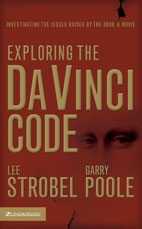
Lee Strobel's Exploring the Da Vinci Code

In the blog entry "The Da Vinci Code-Some thoughts", I found 10 useful books examining the claims of the DVC. But, I missed out one! Lee Strobel also wrote a small (112 pages) but useful guide to help Christians and seekers wrestle with key issues raised by The Da Vinci Code book and movie, gently leading them toward conclusions that are consistent with historic Christianity.

Exploring the Da Vinci Code: Investigating the Issues Raised by the Book and Movie (Willow Creek Resources) (Zondervan, 2006)

Description of book: Exploring the Da Vinci Code takes you on a fascinating journey to London, Paris, and California with Lee Strobel and Garry Poole as they investigate the claims made by Dan Brown in his novel, The Da Vinci Code. It provides quick, straightforward answers to the most troubling aspects of the popular novel and major motion picture, which is scheduled to release in theatres May 19, 2006.

This outreach book is designed so readers can give multiple copies to friends, family, coworkers—anyone who may be struggling with the misconceptions fostered by The Da Vinci Code.

By the way, if one is able to form a class to discuss the issues raised by DVC, there is also the "Discussing the Da Vinci Code Curriculum Kit: Examining the Issues Raised by the Book and Movie" (Willow Creek Resources/Includes 4-Session DVD, 4-Session Discussion Guide), Written by: Garry Poole, Lee Strobel. The four sessions in the DVD address the following questions:

1. What Can History Really Tell Us?
2. Can We Trust the Four Gospels?
3. What’s the Role of Women in Christianity?

4. Is Jesus the Son of God?

This DVD-guided small group forum is designed for use with an accompanying discussion guide that includes questions, sidebar information, background material, Bible verses, and relevant quotes. Each session includes interviews with experts and concludes with facilitator Lee Strobel’s perspective.


"Give Dan Brown credit for being one of the most successful novelists of all time, but there is simply no rational reason to believe his book's audacious rewriting of Christianity."-Lee Strobel, Exploring the Da Vinci Code